


 Organizations are under pressure to modernize their database infrastructure and reduce their reliance on expensive proprietary platforms.

This post looks at what enterprise-grade adds to open-source PostgreSQL, and what to consider when choosing a PostgreSQL enterprise approach.
What enterprise-grade means beyond the open-source core
 Enterprise-grade PostgreSQL adds support, security and governance, lifecycle management, and operational assurance around the open-source PostgreSQL core.
Moving to an enterprise distribution doesn't change PostgreSQL itself. The database engine, the SQL dialect, and the extension ecosystem all stay the same, built on the core that underpins Fujitsu's broader database strategy. That means organizations retain the PostgreSQL database they already know, including its extensibility and ability to run across different operating systems.
What changes is everything built around that core, from who answers when something breaks to who manages the multi-year upgrade path and who proves to an auditor that access controls actually held.
Those additional capabilities fall into four layers:
| Layer | The most common questions it answers |
| Support commitments | Who do we call when something goes wrong? How quickly will they respond? Do they have the PostgreSQL expertise to resolve it? |
| Security and governance controls | How do we control access to sensitive data? How do we demonstrate that those controls are working? Can we provide the evidence an auditor needs? |
| Lifecycle management | Who owns patching and version upgrades? How long will each version be supported? How do we plan upgrades without disrupting critical systems? |
| Operational assurance | How do we keep the database available and performing as expected? What happens if a system fails? Can we recover quickly enough to meet business requirements? |
These questions become more important as PostgreSQL takes on a larger role in enterprise environments. In Stack Overflow's 2025 Developer Survey, PostgreSQL ranked as the database developers most want to keep using for the third year running, with roughly two-thirds of current users planning to stick with it.
None of these layers replace PostgreSQL or fork it into something different. Like an enterprise Linux distribution, they add support and operational structure around the same open-source core. Linux's own path from community project to enterprise standard offers a useful comparison.
Where the difference shows up: support, compliance, and long-term lifecycle
 Community PostgreSQL is a mature open-source relational database with a strong feature set, extensibility through tools such as PostGIS, and an active open-source community. Reliability is already one of its strengths. In Timescale’s 2024 State of PostgreSQL survey, 62% of respondents cited reliability as a reason for choosing PostgreSQL.
The case for an enterprise approach isn't about fixing the PostgreSQL core. It's about adding the support, governance, and lifecycle management organizations need as PostgreSQL takes on more critical workloads:
- Support
Community PostgreSQL relies on community and in-house expertise, without guaranteed response or resolution times. Enterprise support adds defined service commitments and dedicated technical support. - Compliance
Organizations using community PostgreSQL are responsible for putting the security, governance, and auditability their environment requires in place. An enterprise approach provides more structured controls for regulated environments. - Long-term lifecycle
Internal teams are responsible for patches, upgrades, high availability, disaster recovery, and maintaining the expertise needed to support the PostgreSQL database over time. Enterprise support provides more structure around those responsibilities.
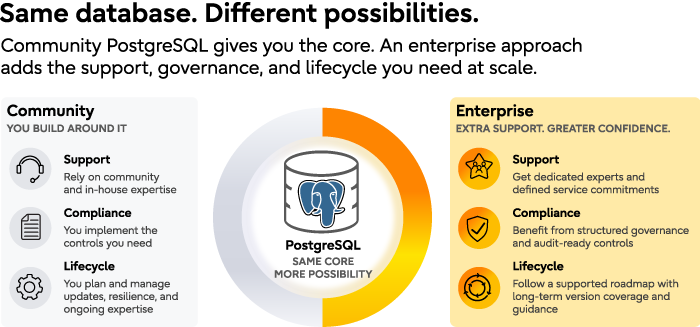
For some organizations, managing these responsibilities internally makes sense. For others, particularly as PostgreSQL takes on more critical workloads, converging open-source software with a commercial support layer provides additional operational support without changing the underlying PostgreSQL platform.
The business case for standardizing on enterprise PostgreSQL
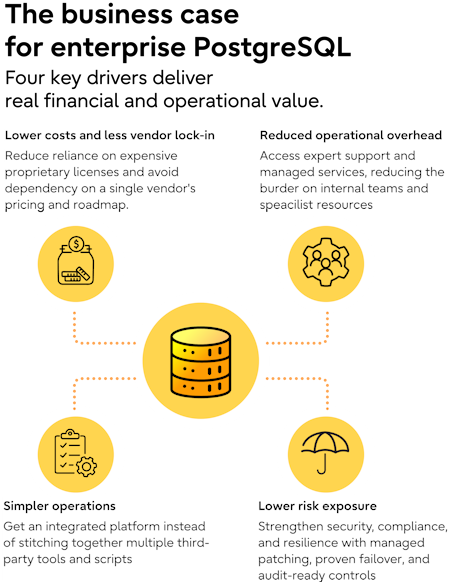
 Standardizing on enterprise PostgreSQL is a cost conversation as much as a technical one, and the cost case rests on four drivers.
- Licensing and vendor cost pressure
Proprietary legacy databases carry licensing costs that scale with usage in ways that are difficult to predict or control, and those costs tend to grow faster than the workloads they support. - Operational overhead
Running community PostgreSQL at enterprise scale requires specialized in-house expertise, dedicated time for patch management, and acceptance of uptime risk if that expertise isn't available around the clock. - Operational complexity
Reaching production-readiness on community PostgreSQL alone can mean stitching together multiple third-party tools and scripts for backup, monitoring, high availability, disaster recovery, and failover. Each addition is manageable on its own, but the accumulated complexity becomes its own maintenance burden over time. - Risk exposure
Unmanaged environments carry compounding risk, from a missed patch to an untested failover to security or compliance issues that only surface during an audit.
Avoiding vendor lock-in — from proprietary platforms and from DIY sprawl
Standardizing on a supported platform can reduce two forms of lock-in. Proprietary vendor lock-in ties an organization to a vendor's pricing and roadmap. DIY lock-in develops when a self-managed PostgreSQL environment becomes dependent on custom tooling, extensions, and the knowledge of a small number of people. As the environment grows, that can make it harder to optimize, upgrade, and standardize.
Both forms of lock-in contribute to an organization's real total cost of ownership, beyond licensing or subscription costs.
What enterprise support commitments actually cover
Enterprise PostgreSQL support typically includes SLA-backed incident response, structured version lifecycle and patch management, and access to dedicated PostgreSQL expertise. Community PostgreSQL, by contrast, relies on community resources and in-house expertise, without guaranteed response times.
| Support area | Community PostgreSQL | Enterprise PostgreSQL |
| Response commitment | Support through community forums, mailing lists, and in-house expertise, with no guaranteed response times. | SLA-backed response times |
| Incident resolution | Depends on available community or in-house expertise | Access to dedicated PostgreSQL engineering expertise |
| Patch management | Public release schedule, self-managed | Structured lifecycle management with proactive patching |
| Version support | Tied to the community's release cadence | Extended, long-term version support |
Service-level agreements and incident response
An SLA-backed response commitment tells an organization how quickly an issue will be acknowledged, but getting the level of PostgreSQL support an organization deserves also means evaluating resolution capability. Access to PostgreSQL engineering expertise often determines how quickly a complex incident can be fixed.
Support also extends beyond individual incidents. Continuity and stability matter more than ever when a major PostgreSQL version reaches end of life. Extended version support gives teams more time to plan upgrades rather than having the community end-of-life date dictate the schedule.
Security, governance, and compliance as architectural requirements
 For enterprise PostgreSQL, security, governance, and compliance need to be designed into the database environment from the start. For regulated industries in particular, adding controls later can create problems during an audit or after an incident.
Four capabilities are central to that approach:
- Audit logging
The technical mechanism that records who accessed what, and when. - Access control
Granular permissions that limit what any given user or application can do. - Encryption
Protecting data at rest and in transit, with controls including SSL and PostgreSQL capabilities such as pgcrypto where appropriate. - Auditability
Turning audit logs into evidence an organization can retrieve, retain, and present when an auditor or regulator asks for it, including through retention policies and reporting.
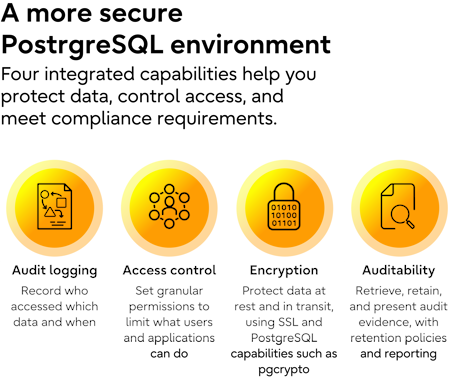
Governance and data security work best when they're built into how the database is administered day to day, not layered on as a separate compliance exercise.
Why compliance readiness is a platform decision, not an add-on
Retrofitting compliance controls onto a system that wasn't designed for them is expensive and often incomplete. Building governance, auditability, and advanced security requirements into the architecture from the outset makes them part of how the PostgreSQL environment operates, rather than controls that have to be added later. Choosing a platform where security best practices are built in from the start avoids that retrofit entirely. These are among the enterprise-grade features that regulated industries should prioritize when evaluating a PostgreSQL platform.
Deployment flexibility across hybrid and multi-cloud environments
 Enterprise PostgreSQL can run on-premises, across hybrid and multi-cloud environments, and in containers using Kubernetes, giving organizations more control over where their databases and data live. Rather than treating cloud and on-premises as an either/or decision, organizations can choose the right environment for each workload and change that decision as their needs evolve.
Four deployment models are particularly relevant:
- On-premises
For workloads with strict data residency or latency requirements. - Hybrid
Splitting workloads between on-premises systems and cloud environments as needs dictate. - Multi-cloud
Running across more than one cloud provider, such as AWS alongside other cloud environments, to avoid dependency on any single one. - Containerized and Kubernetes-based deployments
For teams running PostgreSQL in containers and using Kubernetes to manage deployment and orchestration across environments.
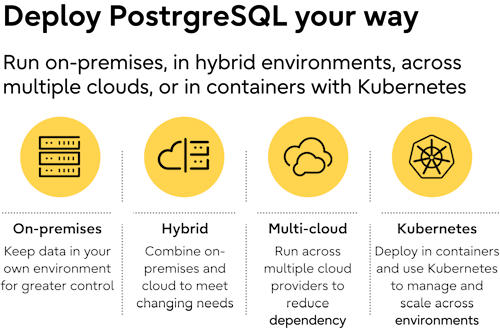
Data sovereignty is often the deciding factor for regulated industries choosing among these models, particularly when data residency requirements are set by law rather than preference.
Avoiding long-term hyperscaler dependency
Committing to a single cloud provider's managed database service can simplify operations, but it also makes that provider's pricing, roadmap, and regional availability long-term considerations. Enterprise PostgreSQL allows workloads to move between environments while retaining a consistent PostgreSQL foundation.
Choosing the right PostgreSQL foundation for your organization
 Four questions can help determine how much enterprise support and governance a PostgreSQL workload needs:
- Workload criticality
What happens to the business if this system goes down? - Compliance requirements
What will an auditor or regulator expect the organization to demonstrate? - In-house PostgreSQL expertise
Does the team have the expertise to support and troubleshoot the environment internally? - Operational ownership
Who is responsible for keeping the platform patched, supported, secure, and running over the long term?
For lower-risk workloads with strong internal expertise and clear operational ownership, community PostgreSQL may be enough. As those requirements increase, so can the need for enterprise support and governance.
Fujitsu Enterprise Postgres brings more than 15 years of PostgreSQL engineering experience, 100% PostgreSQL compatibility, enhanced enterprise security, and 24/7 global enterprise support around the open-source PostgreSQL foundation.
If your organization is weighing how much of that support and governance layer it actually needs, talk with the Fujitsu Enterprise Postgres team about what it would look like for your environment.
Frequently asked questions about enterprise PostgreSQL
Is enterprise PostgreSQL different from PostgreSQL?
Enterprise PostgreSQL is not a different database from PostgreSQL. It adds support, security and governance controls, lifecycle management, and operational assurance around the same open-source core.
When should an organization move beyond community PostgreSQL?
An organization should consider moving beyond community PostgreSQL when a workload becomes mission-critical or its support, compliance, and operational requirements become difficult to manage internally. Organizations without deep in-house PostgreSQL expertise, or those in regulated industries that need auditable compliance evidence, may reach this point sooner than teams running lower-stakes workloads.
What makes PostgreSQL enterprise-grade?
What makes PostgreSQL enterprise-grade is the support, security and governance, lifecycle management, and operational assurance added around the open-source core. The database itself doesn't change.
Is community PostgreSQL secure enough for regulated industries?
Community PostgreSQL provides strong security capabilities, but whether it is secure enough for a regulated industry depends on the governance and controls around it. Regulated organizations may also need auditability, including retention policies and compliance reporting.
How does enterprise PostgreSQL support differ from community support?
Enterprise PostgreSQL support differs from community support by providing contractual response commitments and dedicated technical expertise. Community support is available through open-source community forums and mailing lists, without guaranteed response times. Enterprise support can also include structured, long-term version support.
Does choosing an enterprise PostgreSQL platform create vendor lock-in?
Choosing an enterprise PostgreSQL platform does not necessarily create the same lock-in as a proprietary database engine because it remains based on standard PostgreSQL. Organizations should also consider DIY lock-in, where a self-managed environment becomes dependent on custom tooling or a small number of people with specialist knowledge.


 PostgreSQL Insider


