


 Governance policies become difficult to enforce once data is spread across databases, cloud platforms, applications, analytics environments, and business units.

What is a data governance framework?
 A data governance framework is the structured set of policies, roles, and controls that define who owns data, who can access it, and how it is protected and used. Its purpose is operational consistency: applying the same rules for data ownership, data classification, access controls, data quality, and data security across the organization.
It also defines accountability for data assets and stewardship throughout the data lifecycle, providing a common structure as organizations outgrow a single relational database and information spreads across systems.
The four pillars of a data governance framework
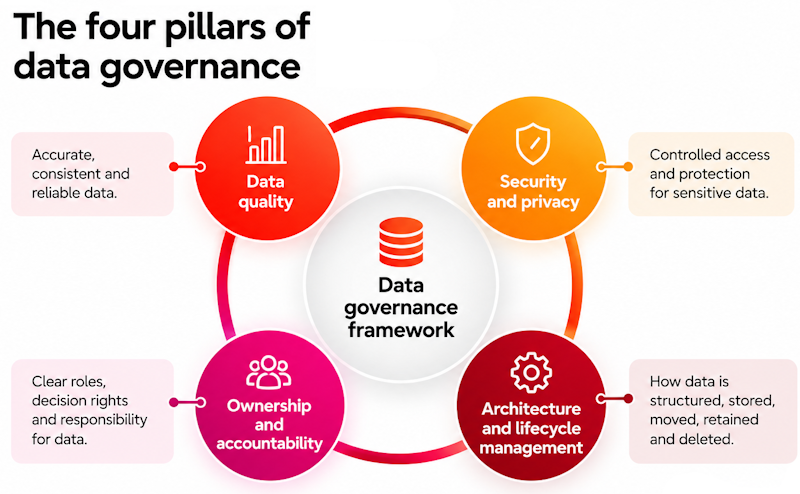
A data governance framework typically organizes governance around four connected pillars: data quality, security and privacy, ownership and accountability, and architecture and lifecycle management.
| Pillar | What it covers | Questions to ask |
| Data quality | The accuracy, completeness, consistency, and reliability of data | Is the data accurate and complete? Are quality standards consistent across systems? |
| Security and privacy | Who can access, use, modify, and share sensitive data | Who can access this data? Do access controls reflect its classification? Can access be audited? |
| Ownership and accountability | The roles, decision rights, and responsibilities associated with data assets | Who owns the data? Who maintains it? Who makes decisions when issues arise? |
| Architecture and lifecycle management | How data is structured, stored, moved, retained, and deleted | Where does the data live? How does it move? Are retention requirements applied throughout its lifecycle? |
Data quality
Data quality establishes whether information can be trusted and used consistently. Governance defines common quality standards, how data quality issues are identified and corrected, and who is responsible for maintaining reliable data across systems.
That trust gap is widespread: 67% of respondents to Precisely and Drexel University's 2025 data integrity research said they don’t entirely trust their organization's data for making decisions.
Security and privacy
Security and privacy turn data classification into appropriate protections. For regulated organizations, security best practices can include role-based access controls, encryption, and audit logs that help demonstrate data security, data privacy, and regulatory compliance.
Ownership and accountability
Clear data ownership establishes who has decision rights over particular data assets and data domains. Data owners provide accountability, while data stewards support day-to-day data stewardship by maintaining definitions, quality standards, and appropriate use.
Architecture and lifecycle management
This pillar governs data from creation and storage through movement, retention, archival, and deletion. Data lineage and metadata management help organizations understand where data came from and how it moves, while a data catalog can make those assets easier to discover and govern. The database features that support classification and retention form part of that wider governance architecture.
Data governance models: how organizations structure decision rights
Even with the same four pillars in place, organizations differ in where decision rights sit and how governance policies are applied day to day.
| Model | Description | Best fit |
| Top-down | A central team defines and enforces governance policies across the organization | A single business line or tightly controlled core environment |
| Bottom-up | Business units define and manage their own governance rules | Decentralized organizations that prioritize local autonomy |
| Center-out | A central team sets non-negotiable standards, while business units decide how to apply them | Large regulated enterprises with multiple business lines |
| Hybrid | Central control of areas such as security, compliance, and data classification is combined with delegated operational decisions | Enterprises operating across on-premises, cloud, and multi-cloud environments |
Enterprise Data Strategy Board’s 2025 State of Enterprise Data Governance Report found 36% of surveyed senior data leaders at billion-dollar organizations used centralized governance, 36% used federated governance, and 29% used a hybrid structure.
Hybrid and center-out models can suit regulated enterprises because some governance requirements cannot vary by business unit. Regulatory compliance, data security, data privacy, and classification need consistent standards, while individual teams still need enough autonomy to manage their own data domains and systems. This becomes particularly important across hybrid environments, where data sovereignty requirements may determine where particular data assets can be stored or processed.
Examples of established data governance frameworks
Organizations rarely need to design a data governance framework from scratch. Established approaches provide reference structures that can be adapted to different operating models, regulatory requirements, and levels of data governance maturity.
| Framework | Core structure | Best fit |
| DGI Data Governance Framework | Organizes governance around decision rights, accountabilities, policies, controls, and a Data Governance Office | Organizations that need a formal structure for governance roles and decisions |
| DAMA-DMBOK | Positions data governance within a broader set of data management practices, including data quality, metadata management, data security, and master data management | Organizations building governance as part of a wider data management strategy |
| DCAM | Assesses data management capabilities using defined objectives, evidence, and maturity criteria | Organizations that want to assess current capabilities and identify areas for improvement |
What these frameworks have in common
 Established frameworks share six characteristics:
- Defined ownership
Named data owners and data stewards have clear accountability for data assets. - Documented policies
Data governance policies establish consistent rules for how data is managed and used. - Metadata visibility
Data catalogs, business glossaries, and metadata management help teams understand what data exists, where it resides, and what it means. - Access controls
Data access is governed according to defined security, privacy, and classification requirements. - Auditability
Audit logs and other records provide evidence that governance controls and decision rights are being applied. - Ongoing review
Policies, controls, and responsibilities evolve as data assets, regulations, risks, and business requirements change.
From framework to enforcement: where governance actually lives
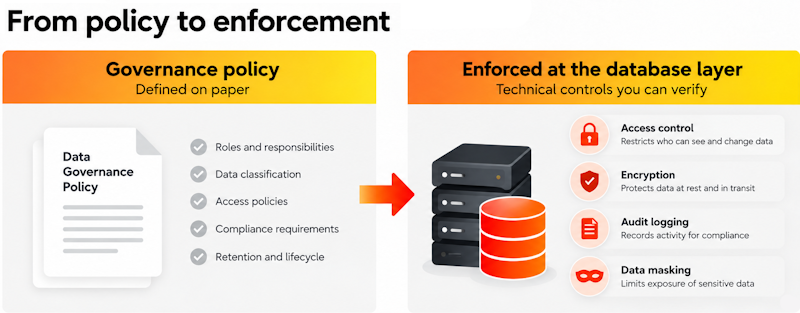
 Data governance becomes real at the point where policy is enforced. An organization can define data owners, document access policies, and establish a data governance council, but none of those measures can by themselves prevent an unauthorized user from accessing sensitive data.
That is why governance has to be treated as an architectural design principle, not a compliance layer added after systems are built. The database layer is where policies governing data access, security, and privacy become technical controls. Access controls determine who can see or change data. Encryption protects it at rest and in transit. Audit logging creates a record of who accessed it and what they did. Data masking limits exposure of sensitive information without preventing legitimate use.
Together, those controls turn a data governance policy into something enforceable and auditable. If a policy says an analyst cannot access a customer's account data, the organization should be able to demonstrate the control preventing that access and produce the audit trail to prove it.
This becomes harder across hybrid environments because the same governance requirements have to remain enforceable across different infrastructure environments. Enterprise database security practices therefore need to be applied consistently wherever governed data resides. For example, a manufacturer running plant-floor systems on-premises alongside cloud analytics needs equivalent controls across both environments as it modernizes its hybrid database environment.
A governance framework should ultimately be judged by whether its policies can be enforced and evidenced at the systems holding the data, not by how comprehensively those policies are documented.
A checklist for building a data governance framework in a hybrid enterprise
 An effective data governance framework needs to be auditable and enforceable across the systems where data actually lives. Use this checklist to translate the framework into operational controls:
- Define ownership and accountability
Assign data owners and data stewards to major data assets and data domains, with clear decision rights and responsibilities. - Classify data first
Establish data classification standards before access policies so controls reflect sensitivity and regulatory requirements. This is particularly important before a database migration, when teams can classify data before it moves. - Define data access policies
Specify who can access each classification of data, what they can do with it, and under which conditions. - Choose the appropriate governance model
Use top-down, bottom-up, center-out, or hybrid governance according to where decision-making authority sits within the organization. - Map policies to technical controls
Confirm that access controls, encryption, audit logging, and other required protections exist at the database layer. Include these requirements when evaluating database migration tools. - Audit governance regularly
Review access, controls, ownership, and data policies as systems, regulations, and organizational responsibilities change.
Governance lives at the data layer
Governance policies need technical controls at the systems where governed data resides. For organizations running PostgreSQL, Fujitsu Enterprise Postgres can help operationalize the security and privacy requirements within a data governance framework.
Fujitsu brings more than 15 years of PostgreSQL engineering experience, while Fujitsu Enterprise Postgres provides enhanced enterprise security capabilities including:
- Transparent data encryption
Protects data at rest with 256-bit AES encryption. - Data masking
Redacts sensitive data in-flight according to defined masking policies. - Dedicated audit logging
Records database activity in a dedicated audit log for monitoring and analysis.
See how Fujitsu Enterprise Postgres enhances PostgreSQL data security or explore its enhanced enterprise security capabilities for more detail.
If you are looking to make your data governance framework enforceable across enterprise PostgreSQL environments, contact Fujitsu to discuss how those governance requirements can be supported at the database layer.
Frequently asked questions about data governance frameworks
What is a data governance framework?
A data governance framework is a structured set of policies, roles, processes, and controls for managing how data is owned, accessed, protected, and used. It provides the operating structure for a wider data governance strategy, helping organizations maintain data integrity, reduce risk, and apply consistent rules as data moves across systems, business units, and cloud environments.
What are the four pillars of data governance?
The four pillars of data governance are data quality, security and privacy, ownership and accountability, and architecture and lifecycle management. Together, they establish whether data can be trusted, who can use it, who is responsible for it, and how it should be managed throughout its lifecycle.
What is the difference between data governance and data management?
Data governance defines the policies, roles, decision rights, and standards for data, while data management puts those decisions into practice. Data management includes activities such as storing, integrating, protecting, and maintaining data. Data governance tools can support both by improving data discovery, documenting ownership, and making governance requirements visible across otherwise disconnected data silos.
What data governance model should a regulated enterprise use?
Center-out and hybrid governance models can suit regulated enterprises because they combine central standards with delegated operational decisions. This allows requirements such as security, privacy, and regulatory compliance to remain consistent while individual data domains retain appropriate autonomy. The right model also depends on regulatory obligations, such as GDPR or CCPA, organizational structure, and risk management requirements.
How does database security relate to data governance?
Database security provides technical controls that help enforce data governance policies. Access controls, encryption, data masking, and audit logging protect data and provide evidence that governance requirements are being followed. These controls also reduce exposure to data breaches by limiting unauthorized access and creating an auditable record of activity at the database layer.
Who should own a data governance framework?
A data governance framework should have clear executive accountability, typically supported by a chief data officer, data governance lead, or equivalent senior role. Data owners and data stewards then provide accountability within individual business areas and data domains. Successful governance also requires change management and data literacy across the organization, since policies only work when the people creating, managing, and using data understand their responsibilities.
Why do data governance programs fail?
Data governance programs often fail when policies, ownership, and technical enforcement become disconnected. Common problems include unclear accountability, data silos, inconsistent controls, limited data discovery, and governance requirements that are never embedded into underlying systems. New uses of big data, business intelligence, artificial intelligence, and AI governance can widen those gaps if the data governance strategy does not evolve alongside them.


 PostgreSQL Insider


