


 SQL Server has been a default choice in enterprise IT for decades. The workloads run, the team knows the platform, and the tooling around it is settled. Nothing about that demands attention on its own.
When should you compare PostgreSQL and SQL Server?
 Organizations typically revisit the SQL Server versus PostgreSQL decision when something forces a reassessment of long-term platform strategy. The most common triggers are:
- Licensing renewal
Rising or changing costs put the current platform under scrutiny. - Cloud migration or application modernization
Moving or rebuilding applications creates a natural opportunity to reconsider the database beneath them. - AI adoption
New vector, embedding, and AI-adjacent workloads can change database requirements. - Lifecycle or governance changes
End-of-support dates or new residency, security, and audit requirements can force a platform reassessment.
The trigger matters. A renewal-driven review may prioritize cost, while a governance-driven review may accept higher costs for greater control.
PostgreSQL vs SQL Server at a glance
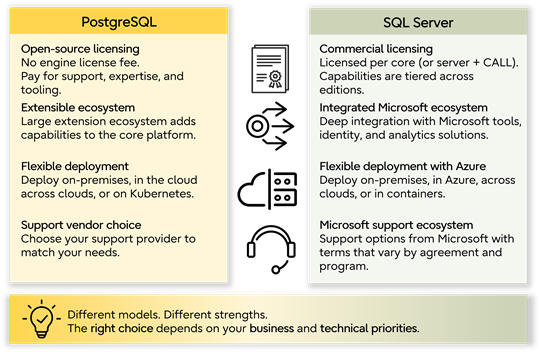
PostgreSQL is an open-source object-relational database available from multiple vendors with commercial support. Microsoft SQL Server is a Microsoft commercial product, licensed per core, with deep integration into the Microsoft stack.
Licensing and cost structure
 This is the dimension most reviews are really about, so it deserves the most weight.
SQL Server is licensed by core, with different rules for physical and virtual environments, so infrastructure decisions can directly affect the licensing requirements. Edition matters as much as core count. Capabilities are tiered across editions, and the ones that push an enterprise estate upward are predictable. Advanced availability group configurations, higher memory limits, and greater compute capacity can require Enterprise Edition rather than Standard Edition. Cost pressure typically originates there rather than in the base license, particularly when workloads need advanced high availability or greater scale.
PostgreSQL carries no engine license fee.
How per-core licensing scales
Per-core licensing couples database cost to infrastructure decisions. Adding cores or consolidating workloads onto larger servers can increase the license requirement. Virtualized and containerized environments introduce additional counting rules that also need to be understood.
The practical effect is that platform cost becomes a constraint on architecture. Teams may size servers around license economics rather than the workload, a real cost that never appears as a line item.
Where PostgreSQL costs actually sit
Moving to PostgreSQL redistributes cost rather than eliminating it. The engine is free. The platform is not.
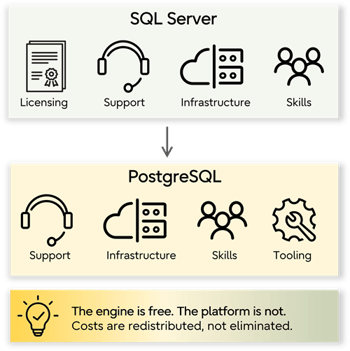
Cost moves into enterprise support with a defined SLA, into the expertise to run it well, and into operational tooling for backup, monitoring, and high availability where required. The honest comparison is total cost of ownership across licensing, support, staffing, and hardware over a multi-year horizon.
Operational efficiency belongs in that calculation. A familiar platform has lower effective cost, while PostgreSQL removes the licensing consequence of adding cores for routine performance work.
Feature parity and where the platforms genuinely differ
 Both platforms handle enterprise transactional workloads at scale.
PostgreSQL is firmly mainstream. In Stack Overflow's 2024 Developer Survey, 49% of developers reported using it, making it the survey's most-used database for the second year running.
A handful of differences matter for enterprise estates.
T-SQL and PL/pgSQL
The language differences are a significant source of migration effort. SQL Server uses T-SQL (Transact-SQL), while PostgreSQL uses standard SQL alongside PL/pgSQL for procedural code. They differ in syntax, error handling, and transaction semantics, so stored procedures, triggers, and functions do not port directly. Effort concentrates in the application layer rather than in moving data.
PostgreSQL uses multi-version concurrency control (MVCC) to let transactions work with different versions of data while minimizing blocking. SQL Server also supports row-versioning-based concurrency, including snapshot isolation. Both platforms support table partitioning.
Extensibility and the extension ecosystem
 The architectural difference is where capability comes from. SQL Server packages capability into the engine and tiers it across editions, which makes it predictable and ties access to license level. PostgreSQL is designed to be extended, and that extensibility is the reason it has spread so widely across workload types. Extensions such as PostGIS for geospatial data and pgvector for vector workloads add capabilities without requiring a different database platform. PostgreSQL also provides native JSON support through JSON and JSONB, alongside indexing options such as partial indexes.
That cuts both ways. Extensions need evaluating, versioning, and supporting, which is governance work a packaged engine avoids.
Analytics and business intelligence integration
SQL Server's integration with the Microsoft stack is a genuine advantage. SQL Server Management Studio (SSMS), SQL Server Integration Services (SSIS), reporting, analytics, identity, and developer tooling form a mature ecosystem around the database. For an organization standardized on that stack, the integration cost of moving is real and frequently underestimated.
PostgreSQL connects to business intelligence tools through standard drivers, which works but is not native integration. If your analytics estate is built around Microsoft services, weigh that carefully.
Support, governance, and operational assurance
 This is the dimension buyers under-weight until an incident forces it.
With a commercial platform, there is an established vendor support model. With PostgreSQL, support is a separate decision, and its quality determines whether the platform is viable for mission-critical work. Choosing PostgreSQL without deciding the support arrangement deliberately can turn cost savings into operational exposure.
Governance and operational requirements are the same on either platform. Data encryption at rest and in transit, auditability that satisfies a regulator rather than a checklist, access controls such as row-level security, backup and point-in-time recovery, patch and version lifecycle management, and a defined escalation path all matter. What differs is how they are obtained. On a commercial platform they are largely features of the edition you licensed. On PostgreSQL they come from the distribution and the vendor, and capabilities like column-level encryption vary in how they are packaged.
Lifecycle is worth checking specifically. Community PostgreSQL supports each major version for five years from initial release, shorter than the commercial platform's mainstream and extended support combined. For an organization with long upgrade cycles, that difference is material.
Deployment flexibility and lock-in
SQL Server runs on-premises, in Azure, on other clouds, and in containers, while Azure SQL Database provides Microsoft's managed cloud database option. The dependency is less about where SQL Server runs and more about its ecosystem, where identity, analytics, tooling, and cloud services are tightly integrated. That integration is convenient, but it also creates dependency.
PostgreSQL runs the same engine across on-premises, hybrid, multi-cloud, and Kubernetes environments, and the vendor relationship is separable from the platform. Changing support vendors does not mean changing databases.
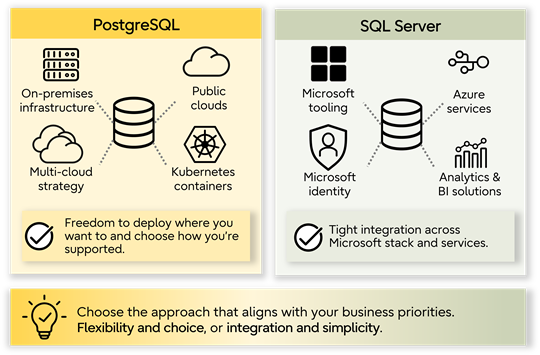
For regulated workloads this connects directly to residency. Where data may legally live is increasingly a constraint rather than a preference, and a platform that runs the same way in a sovereign environment as in a public cloud gives organizations more control over where workloads and data reside without requiring a different database platform.
What a migration actually involves
 A SQL Server to PostgreSQL migration typically involves four areas:
- Schema and datatype conversion: Largely tractable and increasingly tool-assisted.
- Procedural code: T-SQL stored procedures, triggers, and functions need to be assessed and, where necessary, rewritten for PostgreSQL.
- Application changes: This is often where much of the effort sits, particularly where applications depend on SQL Server-specific behavior.
- Testing: Data, application behavior, performance, and operational processes all need validating before cutover.
Moving the data itself is often the easier part. Teams new to PostgreSQL can find the operational assumptions differ more than the SQL does. The real question is which workloads justify the cost and effort of migration.
Choosing between PostgreSQL and SQL Server
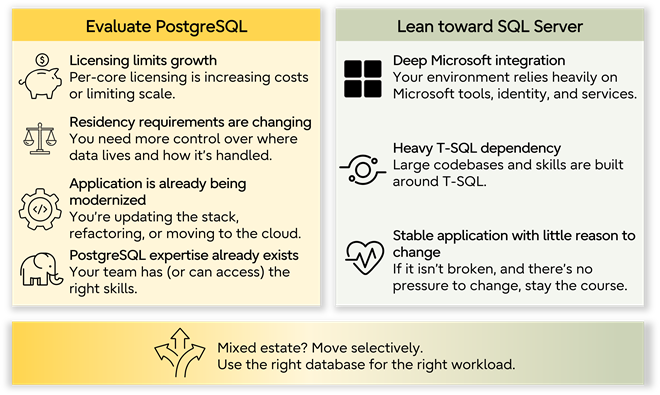
There is no single verdict, and the right answer differs across a portfolio.
| Dimension | PostgreSQL | SQL Server |
| Licensing model | No engine license fee | Per-core, or server plus CAL for Standard |
| Cost structure | Support, expertise, and tooling | Commercial licensing, support, and Software Assurance where applicable |
| SQL and procedural languages | SQL and PL/pgSQL | T-SQL (Transact-SQL) |
| Extensibility | Extension ecosystem | Capabilities packaged in the engine and editions |
| High availability | Streaming and logical replication, external cluster management | Always On availability groups, with capabilities varying by edition |
| Deployment | On-premises, hybrid, multi-cloud, Kubernetes | On-premises, Azure, other clouds, containers |
| Support model | Chosen separately, per vendor | Microsoft support ecosystem; terms vary by agreement |
| Version support | Five years per major version from the community | Ten years: five mainstream plus five extended |
PostgreSQL with the support and governance your SQL Server estate expects
 PostgreSQL by itself does not answer every support, lifecycle, or governance requirement.
Fujitsu Enterprise Postgres addresses those gaps with:
- Enterprise support: 24/7 global coverage with defined SLAs.
- Long-term support: Version support lifecycles run a minimum of seven years and up to ten years after general availability.
- Built-in governance: Transparent data encryption protects data at rest, backups, and internal communication using AES-256, alongside data masking and dedicated audit logging.
- Deployment flexibility: Run on-premises, hybrid, multi-cloud, Kubernetes, and OpenShift.
- PostgreSQL compatibility: 100% PostgreSQL compatibility means organizations can retain the flexibility of an open-source database without introducing a new proprietary dependency.
A global financial market operator chose Fujitsu Enterprise Postgres as its production database platform on OpenShift after its initial PostgreSQL runtime hit performance limits. The platform outperformed its original SQL Server environment, with resilience and high availability among the deciding requirements.
The comparison only takes you so far, because the answer depends on which of your workloads are genuinely candidates. Talk to the Fujitsu team about an architecture review of your SQL Server estate.
Frequently asked questions about PostgreSQL vs SQL Server
Is PostgreSQL better than SQL Server?
Neither is better in general. SQL Server suits organizations that value deep Microsoft integration, while PostgreSQL offers a different cost structure, greater deployment flexibility, and reduced vendor dependency. As an extensible RDBMS, PostgreSQL also supports capabilities such as JSONB, custom data types, and full-text search.
Is PostgreSQL cheaper than SQL Server?
Usually, but not automatically. PostgreSQL removes per-core license fees but shifts cost into enterprise support, expertise, and operational tooling. Compare total cost of ownership rather than licence cost alone.
Can PostgreSQL handle enterprise workloads at SQL Server scale?
Yes. PostgreSQL runs mission-critical workloads at scale. Its scalability is supported by features such as table partitioning and B-tree, GIN, and BRIN indexes. The practical questions are whether high availability, monitoring, backup, and support meet the workload's requirements.
How hard is it to migrate from SQL Server to PostgreSQL?
Moving data is often the more straightforward part. Effort concentrates in T-SQL stored procedures, triggers, and application code that assumes SQL Server behavior. Migration effort generally increases with the amount of logic held in the database.
Does PostgreSQL work with Microsoft tools like Power BI?
Yes. Power BI connects to PostgreSQL through standard connectors and ODBC drivers, although integration is not as tight as with SQL Server. PostgreSQL also supports data warehousing and OLAP workloads, including analytical queries using CTEs and window functions.
Why do organizations move from SQL Server to PostgreSQL?
Common drivers include per-core licensing costs, reducing vendor dependency, data residency requirements, cloud migration, and application modernization.
Can SQL Server and PostgreSQL coexist in the same environment?
Yes. A mixed estate can keep deeply integrated Microsoft workloads on SQL Server while moving suitable workloads to PostgreSQL. Running both requires governance, monitoring, and skills across both platforms.


 PostgreSQL Insider

