


 Enterprise PostgreSQL support is usually evaluated when nothing is wrong. Procurement compares contracts, SLAs, and response times while the databases are running normally.
What enterprise PostgreSQL support actually covers
 Enterprise PostgreSQL support is a contracted service that gives organizations access to PostgreSQL expertise with defined response commitments. It typically covers incident response, patching and version management, troubleshooting, escalation to PostgreSQL engineers, and guidance for production PostgreSQL operations.
PostgreSQL itself is open source and carries no license fee. Enterprise PostgreSQL support adds something the database and community do not: a supplier contractually obligated to respond when help is needed.
Community resources vs. enterprise PostgreSQL support
The PostgreSQL community produces genuinely excellent material. Its documentation, mailing lists, and public body of knowledge provide deep expertise on everything from database administration and performance tuning to replication and PostgreSQL internals.
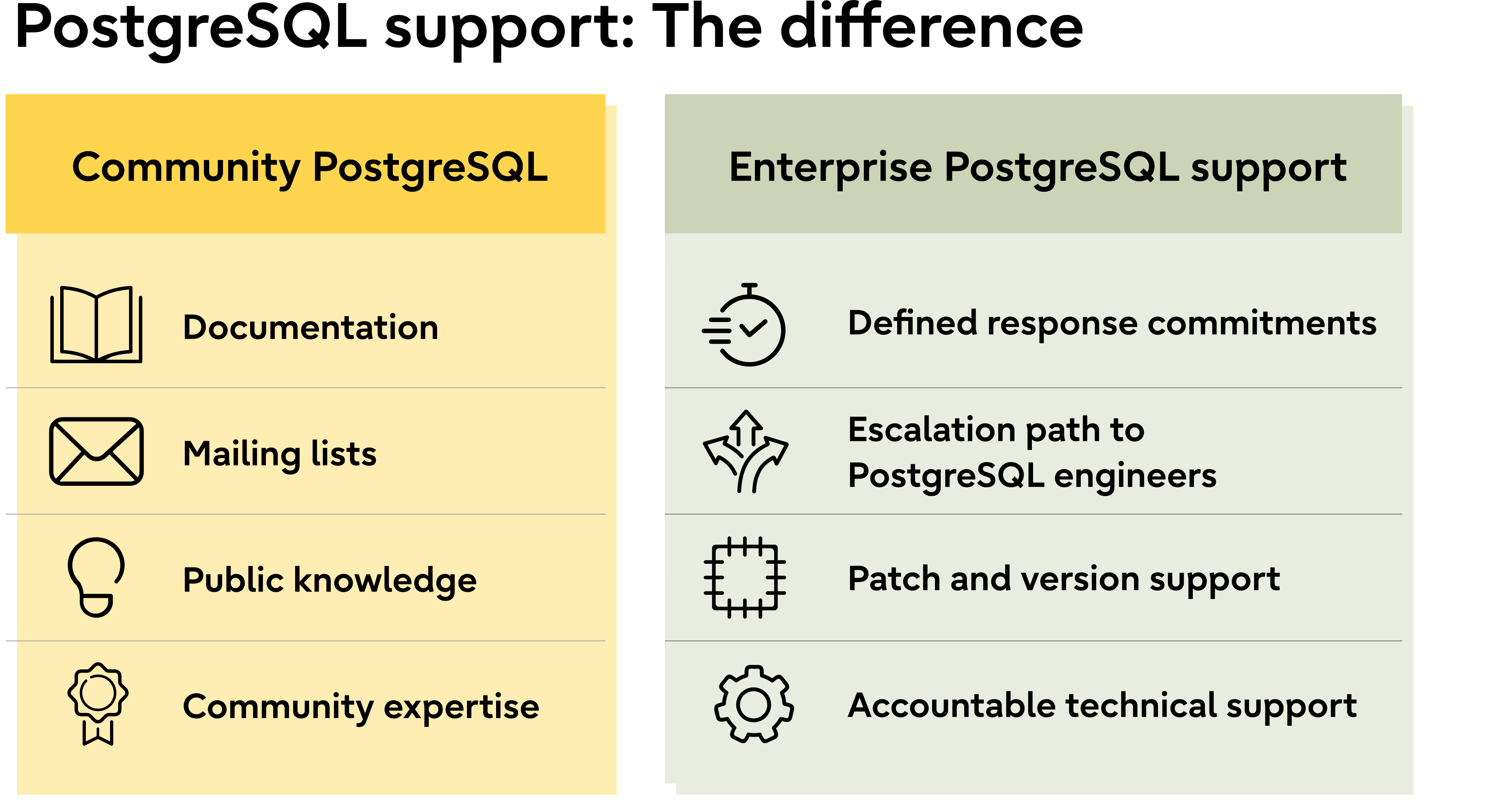
None of it carries an obligation to respond. Enterprise PostgreSQL support fills that operational gap. When a mission-critical application is unavailable, or troubleshooting exceeds the expertise available internally, there is a defined route to technical support and PostgreSQL engineers.
What enterprise PostgreSQL support obligates a vendor to do
 A contract turns best effort into commitment, and the commitments worth checking are:
- Response within a defined time, by severity, with the severity definitions written down
- Coverage across specified hours, including which time zones and whether that extends to holidays
- Escalation to named tiers, with a defined path to engineering
- Resolution ownership, so responsibility does not end with a quick response
- Patches and security fixes for the versions in the agreement
- Guidance on version upgrades and end-of-life planning
What a contract usually does not obligate is a fix within any particular timeframe. A fast response is not the same as a fast resolution, making escalation and resolution ownership just as important as the headline SLA.
Who needs enterprise PostgreSQL support?
Not every PostgreSQL deployment justifies a support contract. The case gets stronger when:

- Downtime affects revenue, customers, or mission-critical applications
- High availability or disaster recovery targets leave little room for extended troubleshooting
- PostgreSQL expertise depends on one or two internal specialists
- The estate spans on-premises, cloud, or Kubernetes environments
- Security or compliance requirements demand accountable patching and support
- The organization needs 24x7x365 support that its internal team cannot provide
A development environment or low-impact internal application may reasonably rely on in-house expertise and community resources. For production workloads, the question is whether the operational cost and risk of being without enterprise support outweigh the cost of having it.
Why the support decision gets made late
 Support is systematically undervalued because its return is invisible until an incident. There is no dashboard showing outages that did not happen. So it gets treated as a line item to minimize rather than an operational capability to specify.
That problem is compounded by who makes the decision. Procurement or finance often evaluates PostgreSQL support as a recurring cost, while the consequences of that decision fall to operations, engineering, compliance, and application teams. The people deciding what level of support to buy are not necessarily the people who will need it during an outage, escalation, or audit.
PostgreSQL is adopted on the basis of licensing savings, often after leaving a proprietary platform. The savings are real and get reported. Support is deferred as an optimization, since the platform is free and the team is capable. Then the first serious incident arrives and it becomes clear that nobody with deep PostgreSQL expertise is contractually obligated to help.
Both halves of that are true at once. The savings were real, and so is the exposure. Enterprise PostgreSQL support is better evaluated as part of the total operational cost of running the database, rather than as a recurring cost to minimize.
How to evaluate enterprise PostgreSQL support
Six criteria separate enterprise PostgreSQL support offerings that look similar on a comparison table.
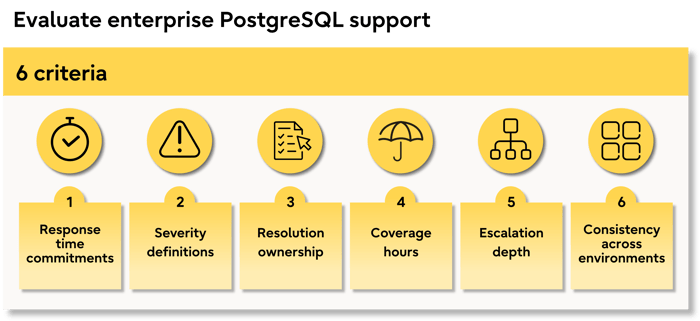

- Response time commitments: A one-hour response usually means acknowledgment rather than resolution. Ask what the SLA measures, what happens during that first hour, and what follows it.
- Severity definitions: If the vendor classifies severity, the definitions matter enormously. Check who assigns severity and how a production outage or degraded mission-critical application is classified.
- Resolution ownership: A vendor can respond quickly, ask for logs, suggest a configuration change, and close the ticket without anything being resolved. Ask who owns a problem through to resolution, including when troubleshooting crosses the database, application, or PostgreSQL infrastructure.
- Coverage hours: Business-hours support in one region is not 24x7x365 support for a global workload. Match coverage to where your PostgreSQL operations, workloads, and teams actually sit.
- Escalation depth: There is a real difference between a support desk that answers questions and an engineering organization that can diagnose a problem in the database itself. Ask whether technical support can escalate to PostgreSQL engineers with deep knowledge of PostgreSQL internals.
- Consistency across environments: If the estate runs on-premises, in AWS or another cloud, and in Kubernetes, check whether the same organization provides PostgreSQL support across the whole estate.
Two questions cut through most sales conversations:
- Ask the vendor to walk you through how they handled a recent severity-one incident, from first response to resolution.
- Ask what the vendor is not obligated to do.
Version lifecycles and patch management
Version lifecycle support is easy to overlook until an upgrade deadline becomes an operational problem.
The PostgreSQL Global Development Group supports a major version for five years after its initial release, after which a final minor release ships and the version is considered end-of-life.
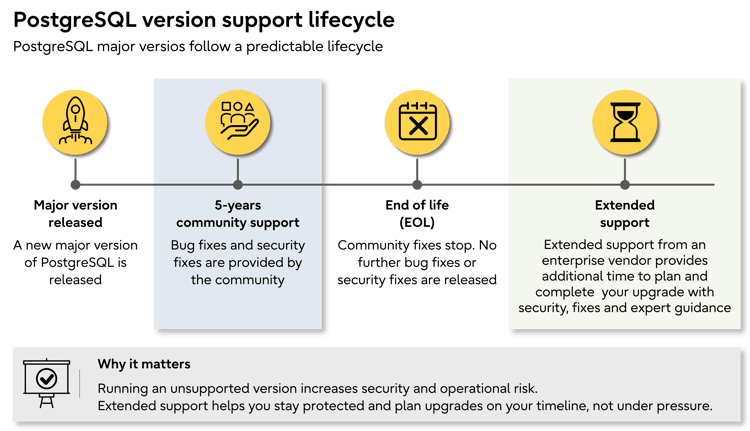
The PostgreSQL versioning policy publishes the current schedule, including the security and bug-fix support available for each major version.
What happens at end of life
 Nothing dramatic happens on the day. What stops is community bug and security fixes, so newly identified vulnerabilities will not be patched in that version by the PostgreSQL project.
That creates both security and compliance exposure. Vulnerabilities can remain unresolved, while organizations subject to security or governance requirements may need to demonstrate that their PostgreSQL infrastructure remains on supported software.
Planning upgrades on your own cadence
 Large estates cannot always upgrade on a five-year cycle dictated by an external calendar. Application certification, vendor support matrices, change freezes, and testing capacity all constrain when an upgrade can realistically happen.
Extended version support buys the ability to plan upgrades against business cycles rather than end-of-life dates. For organizations running large PostgreSQL estates, that means upgrades can align with testing capacity and planned change windows rather than being driven solely by an end-of-life deadline. Keeping current on PostgreSQL versions and their improvements becomes a planning exercise rather than a deadline.
Support requirements in regulated environments
Compliance changes what support has to demonstrate as well as what it has to deliver.
When evaluating enterprise PostgreSQL support for a regulated workload, check three areas:

- Accountability
Auditors ask who is accountable for the platform, how vulnerabilities are assessed and patched, and what happens when an incident requires escalation. Your support model should make those responsibilities clear rather than leaving them with an informal internal or community resource. - Evidence and governance
You may need to demonstrate that defined processes were actually followed. Check whether you can retain evidence of patch timelines, version status, support cases, escalations, and configuration changes made during troubleshooting. These records complement the database audit trail and broader security practices. - Support access and data residency
If a support engineer needs access to a production system to diagnose a problem, that access may expose them to sensitive data, so sovereignty requirements apply to the support relationship as much as to the deployment. For government, defense, and other regulated workloads, check who can access the environment, from which jurisdictions, and how that access is governed and recorded.
Reactive support and proactive assurance
 There is a difference between a vendor you call when something breaks and one already engaged with the environment before it does.
The reactive model is well understood. Something fails, a ticket opens, the clock starts. The proactive model covers health checks, configuration review, capacity and performance advisory, and upgrade planning conducted while the system is healthy.
Proactive assurance is not necessary for every PostgreSQL environment. Its value is highest where high availability, performance, or scalability problems carry significant operational consequences and internal teams do not have the capacity or PostgreSQL expertise to identify them early.
The aim is not to eliminate incidents, but to identify avoidable risks before they become incidents. Proactive monitoring can expose capacity trends, while performance monitoring and query optimization can address degradation before it affects users. Ongoing monitoring and routine performance work remain important regardless of who performs them.
Building the internal case for enterprise support
Defending the line item requires numbers that the finance function recognizes. Build the case around four costs and risks:
 Downtime
Calculate the cost of an hour of downtime for the specific workloads involved, which the business owners can usually estimate better than the technical team. For context, ITIC’s 2024 Hourly Cost of Downtime Survey found that more than 90% of midsize and large enterprises put the cost of an hour of downtime above $300,000. Once you understand downtime costs, estimate how long recovery could take without expert PostgreSQL support.- Internal expertise
Compare enterprise support with the cost of maintaining equivalent PostgreSQL expertise internally. Covering 24x7x365 support requires enough people to provide continuous coverage rather than relying on one specialist. - Unsupported versions
Quantify the security and operational exposure from running unsupported versions, including unpatched vulnerabilities and the cost of an accelerated upgrade if extended support is unavailable. - Compliance
Identify any requirements for supported software, patch timelines, accountable technical support, or evidence of how incidents and vulnerabilities are handled. Where these apply, enterprise support may be a requirement rather than an optional safeguard.
Frame the whole thing as total cost of ownership rather than cost avoidance. The licensing savings from adopting PostgreSQL are real and typically substantial. PostgreSQL's open source ecosystem gives organizations a choice of commercial vendors for additional capabilities and support. The relevant comparison is the total cost and operational risk of each support model, not the cost of enterprise support against zero.
What Fujitsu brings to mission-critical PostgreSQL operations
For mission-critical PostgreSQL operations, the useful measure of support is what changes operationally.
For teams running mission-critical PostgreSQL, Fujitsu Enterprise Postgres support is designed to reduce the operational uncertainty behind those criteria:

- Incidents have a clear escalation path
Fujitsu provides 24/7 global support with defined SLAs and access to PostgreSQL expertise. This gives teams a defined route for escalating complex problems rather than relying on whoever is available internally. - Upgrade timing is easier to control
Long version support lifecycles give teams more flexibility to plan upgrades around testing, application dependencies, change windows, and business cycles rather than an approaching end-of-life date. - The support model follows the workload
Fujitsu supports Enterprise Postgres across multiple deployment models, including Kubernetes, helping teams maintain access to PostgreSQL expertise as their infrastructure changes. - Accountability is easier to demonstrate
For regulated and sovereign workloads, a defined support relationship provides a named accountable party, documented support processes, and the ability to work within jurisdictional requirements.
For teams building their PostgreSQL expertise, proactive support engagement can also provide access to deeper expertise before the next production incident becomes the learning environment.
The criteria in this article are worth putting to any vendor you are considering, Fujitsu included. Talk to the team about what support would look like for the workloads you are actually running.
Frequently asked questions about enterprise PostgreSQL support
Does PostgreSQL come with official support?
No. PostgreSQL is developed by a global community as an open source database, and there is no vendor obligated to respond when something breaks. The community provides documentation, mailing lists, and a large public body of knowledge, all genuinely valuable and none of it contractual. Organizations needing accountable technical support, troubleshooting, response times, escalation paths, or patch management can obtain enterprise PostgreSQL support from a commercial provider.
What should an enterprise PostgreSQL support SLA include?
An enterprise PostgreSQL support SLA should define response time commitments by severity, coverage hours, who assigns severity, and a defined escalation path to PostgreSQL engineers. It should also cover patch and security fix commitments and resolution ownership, meaning who holds a problem through to closure rather than only who answers first. For mission-critical applications, check whether 24x7x365 support is available.
How long is a PostgreSQL major version supported?
Five years from initial release. After the five-year anniversary, a final minor release ships and the version is considered end-of-life. The PostgreSQL versioning policy publishes the current lifecycle for each version. After that date the version receives no further security patches from the community. Some commercial enterprise support providers extend support beyond the community window, giving organizations more time to plan upgrades.
What are the risks of running PostgreSQL without commercial support?
The main risks are unpredictable incident resolution, gaps in PostgreSQL expertise, and greater exposure when versions reach end of life. An incident requiring deep expertise depends on whoever is available rather than on a commitment, so resolution times become unpredictable. For mission-critical PostgreSQL operations, that can affect high availability and disaster recovery objectives as well as security and compliance requirements.
How does enterprise support differ from managed database services?
A managed service operates the database for you, handling provisioning, backups, patching, and availability within the provider's platform. Enterprise support leaves database administration and PostgreSQL operations with your team and supplies expertise, response commitments, and patch management on top. That can provide more control over PostgreSQL infrastructure running on-premises, in AWS or other clouds, or in Kubernetes while retaining access to expert support.
Do all enterprise PostgreSQL workloads require commercial support?
No. Development environments, internal tools, and workloads where extended downtime is tolerable may not require commercial PostgreSQL support. The case strengthens as downtime carries revenue or regulatory consequences, high availability and disaster recovery requirements become tighter, or PostgreSQL expertise concentrates in one or two people. Assess the need for enterprise support per workload rather than as a single decision across the estate.


 PostgreSQL Insider

