




 As that environment grows, maintaining the same level of control becomes more difficult. Different teams may work with the same data in different systems, definitions can diverge, and access permissions can remain in place long after the original need has disappeared. The consequences extend beyond IT, from more difficult audits and compliance gaps to inconsistent reporting and less confidence in the data behind business decisions.
This guide explains what enterprise data governance involves, the core components of an effective governance framework, and the tools and practices that help organizations maintain it as their data environments evolve.
What enterprise data governance actually means
Enterprise data governance is the framework of policies, roles, standards, and processes that defines how an organization owns, accesses, uses, changes, and protects its data. It establishes accountability for data throughout its lifecycle and provides the rules that data management, data quality, and data security put into practice.
Data management, data security, and data governance overlap, but they solve different problems:
| Discipline | What it governs | Questions it needs to answer |
| Data governance | Ownership, policy, standards, and accountability | Who owns this data? What rules apply to it? Who is accountable for its quality and appropriate use? |
| Data management | How data is collected, stored, integrated, maintained, and used | Where does the data live? How does it move between systems? How is it maintained throughout its lifecycle? |
| Data security | Protection against unauthorized access, use, or change | Who can access this data? What level of access do they need? How is sensitive data protected? |
How data governance differs from data security and compliance
Regulatory requirements define the obligations an organization must meet, while governance establishes who is responsible for meeting them. Security provides many of the controls used to protect data, while governance defines the policies and accountability those controls support.
Why data governance has become a board-level priority
 Data governance has become a board-level priority because the quality, control, and availability of enterprise data now directly affect business risk, regulatory compliance, operational performance, and the decisions leaders make. As data spreads across more systems and teams, weaknesses in how it’s governed are no longer contained within IT.
For business leaders, that shows up in several ways:
- Regulatory and compliance risk
Regulations and frameworks such as HIPAA and PCI DSS require organizations to control access to sensitive data and demonstrate that those controls are working. Clear ownership, access policies, and audit trails help organizations meet security requirements in regulated environments and provide evidence of compliance. - Decision confidence
Leaders need to know that the data behind forecasts, investments, and operational decisions is accurate and consistent. When different systems produce different versions of the same metric, the issue quickly moves beyond data quality to whether the business can confidently act on what it sees. - Operational complexity
As data moves between on-premises infrastructure, cloud services, SaaS applications, and third-party systems, maintaining consistent ownership, definitions, and controls becomes harder. - Audit readiness
Clear ownership, data lineage, access records, and audit logs reduce the need to reconstruct evidence when an audit or regulatory request arrives. - Cost and efficiency
Poor-quality data creates additional work as teams reconcile datasets, resolve conflicting definitions, correct errors, and trace problems across systems.
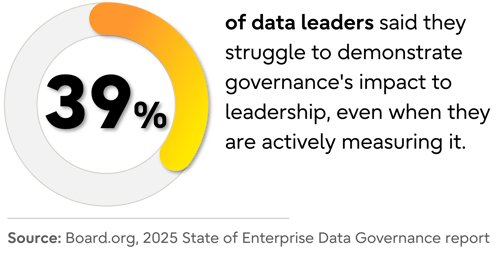
Demonstrating that value remains difficult. In Board.org's 2025 State of Enterprise Data Governance report, 39% of data leaders said they struggle to demonstrate governance's impact to leadership, even when actively measuring it.
For boards, the case for governance is therefore about outcomes as well as controls: more trusted data, clearer evidence of regulatory compliance, and greater accountability.
The core components of a data governance framework
A data governance framework starts with clear ownership: who owns which data, what rules apply to it, and how the organization knows those rules are being followed. Technology can support that framework, but it can’t make those decisions.
Data stewardship and ownership
 Every important data asset needs clear ownership and stewardship.
- Data owners
Accountable for how data is used, protected, and governed. - Data stewards
Manage that data day to day, maintaining its quality and applying governance policies in practice.
Together, they ensure accountability doesn't become fragmented across the teams and systems using the same data.
Policies, standards, and metadata management
Data governance policies, standards, and metadata give teams a consistent basis for managing data.
- Policies define how data should be accessed, used, retained, and protected.
- Standards set consistent expectations for data quality.
- Metadata and cataloging document what data contains, where it came from, and who owns it.
These elements make data easier to find, understand, and use consistently across the organization. They also support AI readiness by helping teams identify data that is reliable, appropriately governed, and suitable for AI initiatives.
Access control and auditability
Access control and auditability put governance policies into practice and provide evidence that they are being followed.
- Access controls determine who can access or change data and under what conditions.
- Audit logs record data access and changes, creating a traceable record for audits and compliance.
At the database layer, features regulated industries should prioritize include row-level security, audit logging, and role-based access control.
Common data governance challenges in hybrid enterprise environments
The central challenge of governing data in a hybrid enterprise is maintaining consistent ownership, standards, and controls as data moves across systems that were not designed to operate under one governance model.
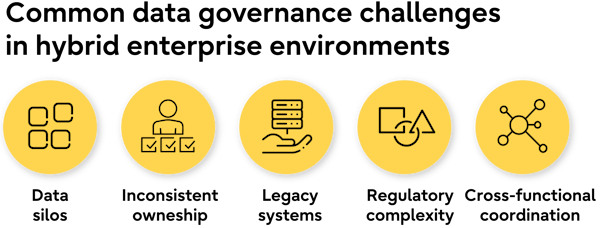
The problems tend to appear in a few predictable places:
- Data silos

Data spread across on-premises infrastructure, cloud platforms, SaaS applications, and different data domains can develop inconsistent definitions and standards. Flexera’s 2026 State of the Cloud Report found that siloed applications remain the most common reason organizations operate across multiple clouds. - Inconsistent ownership
Data can move between teams without responsibility moving with it. A customer might update their billing address through a sales platform, but the change fails to reach finance. Sales owns the CRM, finance owns billing, and IT owns the integration, but responsibility for fixing the customer record remains ambiguous. In fact, in Secoda’s 2025 data governance research, 47% of data leaders identified unclear ownership and accountability as the biggest barrier to scaling data governance. - Legacy systems

Older platforms may lack the metadata, lineage tracking, access controls, or audit capabilities needed for modern governance, making consistent policies harder to apply as data moves between legacy and cloud systems. These limitations can contribute to enterprises outgrowing existing relational database platforms. - Regulatory complexity

Governance has to control where sensitive data is stored as well as who can access it. An organization may be permitted to process customer data in one country but restricted from storing it in another, so data sovereignty requirements must be maintained across on-premises systems, cloud regions, and third-party services. - Cross-functional coordination

Governance often depends on several teams completing different parts of the same control. Security may define an access policy, infrastructure configures the database, and application teams manage user permissions. A policy change therefore has to be coordinated across every team and system it affects, increasing the likelihood that controls will be applied inconsistently.
The business benefits of a mature data governance program
Mature data governance gives leaders greater confidence in enterprise data by establishing where it came from, who owns it, and what controls apply to it.
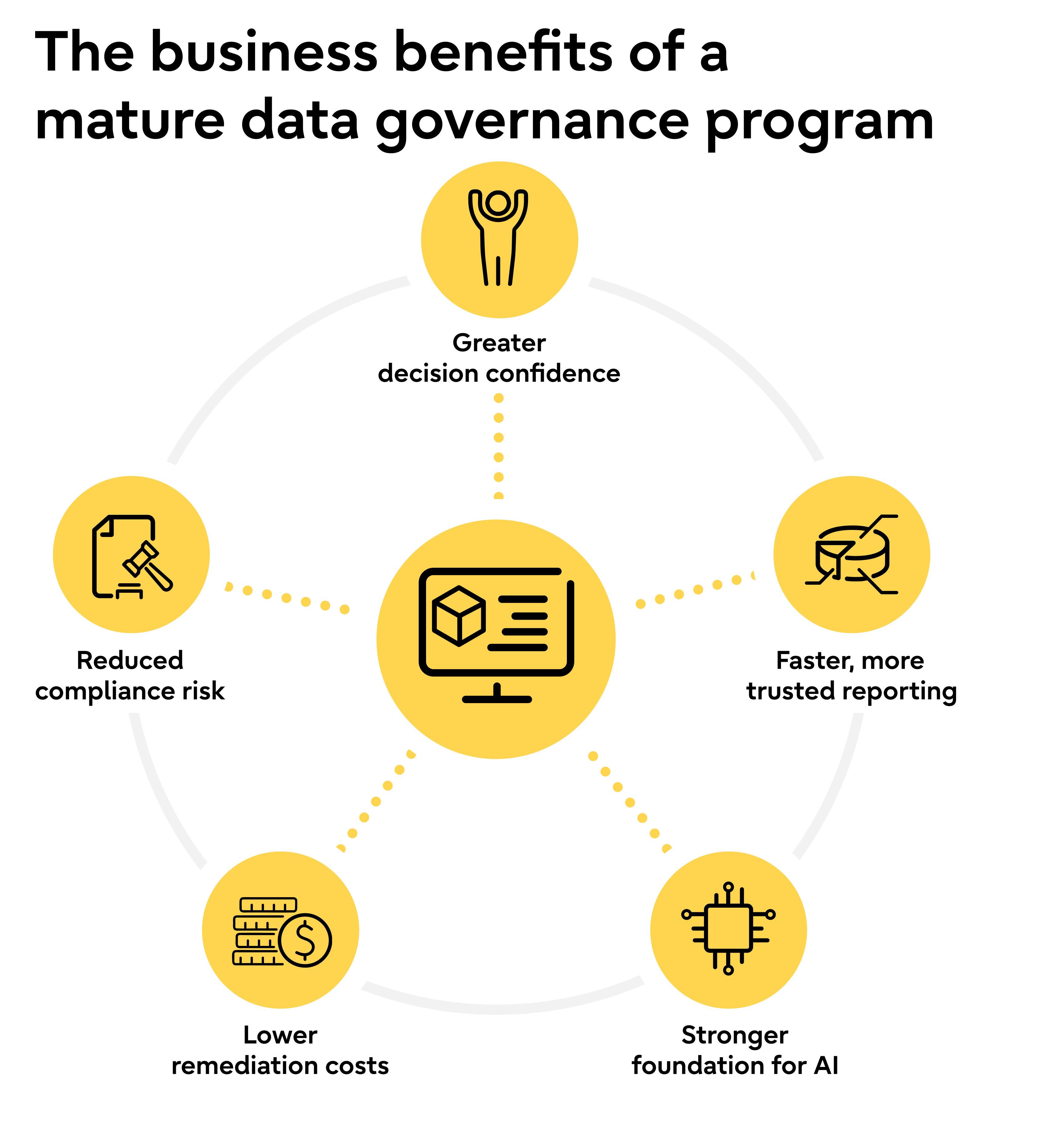
This leads to a range of positive outcomes:
- Greater decision confidence

Established ownership, definitions, and data quality standards give leaders greater confidence in the information behind financial, operational, and strategic decisions. Precisely’s 2023 data integrity research found that just 46% of data professionals reported high levels of trust in their decision-making data. - Reduced compliance risk
Clear ownership, access controls, retention policies, and audit logs make regulatory requirements easier to apply consistently and provide evidence that controls are working when an audit takes place. - Faster, more trusted reporting

Consistent definitions and data quality standards reduce time spent reconciling conflicting figures across systems and teams. This gives leaders reliable information sooner. - Lower remediation costs

Metadata, data lineage, and clear ownership reduce the time and effort needed to trace affected systems, identify responsibility, and resolve data quality issues. - A stronger foundation for AI

Mature governance improves the ownership, quality, and control of data used by AI initiatives. Deloitte’s 2025 Chief Data Officer Survey found that 67% of CDOs at organizations with higher perceived data maturity prioritized AI or generative AI, compared with 63% of those at less mature organizations prioritizing data governance.
Tools and technologies that support enterprise data governance
Governance tools can make data discoverable, monitor quality, and enforce access policies, but they cannot replace ownership, policy definition, accountability, or operational discipline.
| Tool or technology | Role in data governance |
| Data cataloging and metadata management | Makes data assets discoverable and records information such as definitions, ownership, source, and lineage. |
| Data quality monitoring | Identifies missing, inconsistent, duplicated, or unexpected data so teams can investigate problems against defined quality standards. |
| Access control and audit logging | Enforces who can access or change data and creates audit logs showing how data has been accessed and used. |
| Database platform | Enforces governance controls at the point where data is stored and accessed, including permissions, encryption, auditing, and data masking. |
Many governance and security responsibilities sit with database administrators, making database-layer controls an important part of enforcement. Fujitsu Enterprise Postgres supports this with transparent data encryption, data masking, and dedicated audit logging built into the database layer.
Building a data governance strategy you can scale
 Data governance is an ongoing practice. As data, systems, regulations, and business requirements change, governance needs to change with them. A scalable strategy starts with clear ownership and policy before tooling, then revisits those decisions as hybrid and multi-cloud environments evolve.
Fujitsu Enterprise Postgres is built around security best practices for enterprise databases, with capabilities including:
- Governance and auditability controls at the database layer
- 24/7 enterprise support
- Deployment flexibility across on-premises, hybrid, and multi-cloud environments
These capabilities support ongoing governance without replacing the ownership, policies, and processes that define the program.
Talk to our team about building a governance-ready database foundation for your environment.
Frequently asked questions about enterprise data governance
What is the difference between data governance and data management?
Data governance defines data ownership, policies, and accountability, while data management covers the day-to-day work of storing, moving, maintaining, and using data. Governance sets the rules that data management follows throughout the data lifecycle, helping maintain data consistency across systems and teams.
Who should own data governance in an enterprise organization?
Enterprise data governance should have a clearly designated senior owner, supported by stakeholders across the organization. Responsibility may sit with a chief data officer, senior data leader, or cross-functional governance council, but data ownership also needs to be clearly assigned at the dataset or data-domain level.
What are the first steps to building a data governance framework?
Start by identifying high-value or high-risk data, assigning clear ownership, and defining the policies that govern how it is accessed, used, protected, and retained. Once those foundations are established, data governance tools and automation can support policy enforcement and ongoing monitoring.
How does data governance support regulatory compliance?
Data governance supports regulatory compliance by establishing ownership, access controls, policies, and auditability for regulated data. This helps organizations manage data privacy and data compliance requirements and demonstrate how sensitive data is accessed, used, and protected.
What is the biggest challenge in enterprise data governance?
The biggest challenge is maintaining consistent ownership and policy enforcement as data spreads across more systems, teams, and environments. Governance policies can quickly lose effectiveness if responsibilities become unclear or controls are applied inconsistently as the organization grows.
Is data governance a technology problem or a people problem?
Data governance is primarily a people and process discipline supported by technology. Data governance solutions can automate controls, monitor data, and support policy enforcement, but they cannot decide who owns a dataset, establish accountability, or resolve conflicting responsibilities between teams.


 PostgreSQL Insider


