


 Most large organizations have something to point to on AI in 2026, whether that’s a pilot, vendor conversation, or promising prototype. When the question comes up at board level, there is an answer ready.
What AI-ready data means
 AI-ready data is data that is accurate, complete, contextual, governed, and current enough for a specific AI use case. The qualifier at the end carries most of the weight, because readiness is relative to what the data is being asked to do rather than a state a dataset reaches once and holds.
The practical consequence is that "is our data AI-ready?" has no answer. "Is our billing data ready for an automated triage model?" does.
Ask it that way and the real obstacle usually surfaces immediately. The data is scattered. The customer record lives in the CRM, transaction history in the core platform, support interactions in a ticketing system, and the product catalog in something an acquired business brought with it. These data silos create a data integration problem before an AI project even gets to the model. Each holds its own definition of a customer, and none agrees on which is authoritative. Reconciling that takes time because naming the authoritative system means deciding which team was wrong.
Gartner research highlights the scale of the problem: 63% of organizations may not yet have the data management practices they need for AI, while 60% of AI projects that lack AI-ready data are expected to be abandoned through 2026.
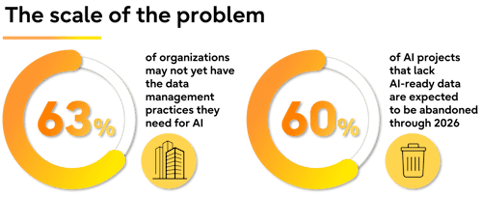
Source: Gartner Lack of AI-ready data puts AI projects as risk (February 2025)
Why AI-ready is not the same as high-quality
Data that passes conventional data quality checks can still be unusable. Structured data such as a customer table with no nulls, consistent formatting, and referential integrity intact is high quality by any traditional measure. It may still lack the metadata that tells a model what a field means, the data lineage that traces an output back to its source, or the freshness the use case requires.
Readiness depends on the use case
A retrieval system answering questions from internal documentation needs different things than a fraud detection model scoring transactions in real time. The first needs good chunking, accurate metadata, and content reflecting current policy. The second needs sub-second freshness, complete transaction history including edge cases, and audit evidence for every decision.
Assessing readiness in the abstract produces a maturity score nobody acts on. Assessing it against a named use case produces specific gaps with owners attached.
The dimensions of readiness that matter
Six dimensions determine whether data can support a model, and each fails in a way the team usually misreads as something else.
That remains a practical barrier even for organizations further along with AI. Gartner found that 29% of leaders at more AI-mature organizations still cited data availability and quality as a major implementation challenge.
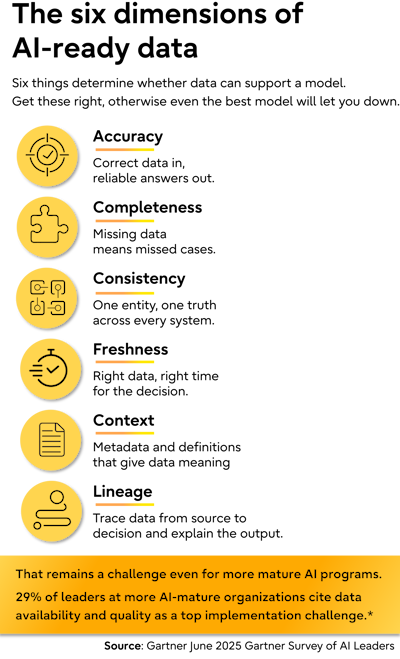
- Accuracy
A model trained or retrieved against wrong examples produces confidently wrong outputs. The error surfaces when someone challenges a decision and the answer cannot be defended. - Completeness
Gaps in coverage teach a model that certain cases do not occur, so it handles them badly when they do. Rare cases are usually the consequential ones, which is why coverage matters more than volume. - Consistency across systems
When the same entity is defined differently in three places, the model learns from a blend of definitions. Its outputs then reconcile with no single system of record, and every disagreement becomes an argument about whose number is right. - Freshness and pipeline latency
Freshness is measured against the decision rather than the clock. A model recommending weekly replenishment is fine with overnight data. A model approving a transaction in flight is not. The data pipeline can work perfectly while the model scores against a state of the world that has moved on. - Metadata, semantics, and context
A column called status with values 1 through 6 is meaningless to anything that does not already know the encoding. Definitions, valid ranges, and relationships between entities captured in a data catalog are what let a model, or the engineer building around it, use a field correctly. Without that layer, every project repeats a discovery exercise someone already did and never wrote down. - Lineage and traceability
Lineage records where data came from and what happened to it in transit. When a model produces a disputed output, the question is not only what the model did but what it was looking at. For regulatory compliance, organizations may need to trace what data informed a decision, particularly in regulated sectors such as financial services.
Governance is the part that fails first
Data governance is where readiness programs break down, because it is the one dimension no tool purchase resolves. Software can profile data quality and generate data lineage. It cannot decide who is accountable for a dataset or what counts as acceptable use of it.
Controlling access to training and inference data
 Data used for training or inference inherits the sensitivity of its source. Moving restricted records into a model doesn't remove those restrictions; it makes them harder to see.
The control questions are the ordinary ones: who can access it, whether that access is logged, and whether it can be revoked. What changes is that access controls have to hold across a pipeline rather than a table. Sensitive fields may also need to be masked or excluded before data reaches the model.
Residency constraints on AI workloads
Where data can be processed is often more constrained than where it can be stored, and AI workloads move data more than reporting workloads do. An inference call to a hosted model is a data transfer that may cross a boundary nobody approved. Data sovereignty considerations apply to every copy and every processing location, including embeddings derived from restricted source data.
Evidence closes the set. When a regulator, auditor, or customer asks how a model reached a decision, the answer is assembled from records kept at the time, and dedicated audit logging covering who accessed which data is part of that record. It cannot be retrofitted once the question arrives.
What this asks of the database layer
 A great deal of readiness work gets pushed into data pipelines and external platforms when the database itself could carry it, often because of inherited data architecture rather than a deliberate decision. Every hop between systems adds latency, adds cost, and adds another place where data lineage breaks and data governance has to be reapplied.
Transactional data can provide the current system-of-record view rather than a copy of one. Access controls and masking applied at the source travel with the data. Audit logging captures what was touched at the point it was touched.
This is not an argument that everything belongs in the database. Training pipelines, feature engineering at scale, model hosting, and large unstructured data often belong elsewhere. The narrower point is that where data is already operational and governed, keeping enterprise AI closer to the database can avoid unnecessary copies, drift, and additional governance perimeters.
Keeping vectors alongside operational data
Vector embeddings are the clearest case. Storing them alongside the operational data they derive from means fewer copies, less drift between what a model sees and what the system of record says, and one governance perimeter instead of several.
When storing and querying embeddings in PostgreSQL, vector similarity and SQL filters can combine in a single query rather than requiring an application-layer join between systems. Choosing the right query depends on the distinction between similarity and distance, which matters when tuning retrieval quality.
Supporting retrieval-augmented generation
 Retrieval-augmented generation (RAG) lets large language models (LLMs) answer from organizational knowledge without retraining. It also makes data readiness immediately visible: the model can only answer from what retrieval returns.
A RAG pipeline puts specific demands on the data layer. Content needs meaningful chunks, embeddings must stay synchronized with source content, and retrieval depends on metadata for filtering before ranking. Access controls have to apply at retrieval time, so a user does not receive an answer assembled from documents they are not entitled to see.
That last point is routinely missed. A retrieval system that ignores entitlements is a data leak with a conversational interface, and applying the filter in the same query as the similarity search is safer than filtering afterward in application code. Improving retrieval quality with better context can also help the model retrieve more useful information, while semantic capabilities in PostgreSQL 18 can reduce the need for additional infrastructure.
What to fix before you start an AI project
 Start with the use case rather than the platform. Identify the use case and the decision it supports. Work back to the data that decision requires. Establish where it lives, who owns it, and how current it is. Close the data governance gaps. Then build the data pipeline.
Starting with the platform and looking for a use case afterward produces infrastructure nobody can justify and a readiness assessment with no criteria.
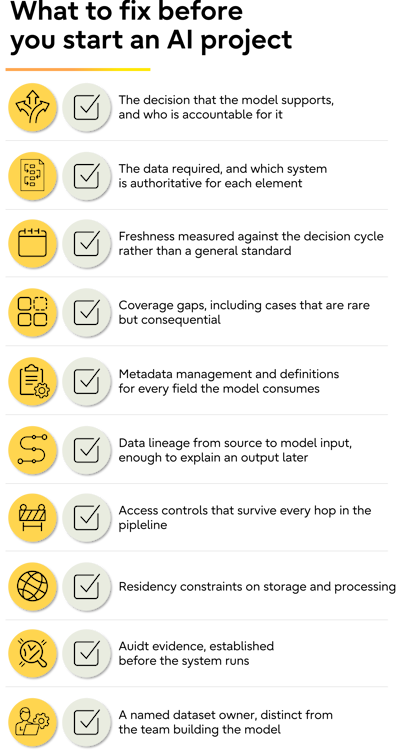
A readiness check against a named use case covers:
- The decision the model supports, and who is accountable for it
- The data required, and which system is authoritative for each element
- Freshness measured against the decision cycle rather than a general standard
- Coverage gaps, including cases that are rare but consequential
- Metadata management and definitions for every field the model consumes
- Data lineage from source to model input, enough to explain an output later
- Access controls that survive every hop in the pipeline
- Residency constraints on storage and processing
- Audit evidence, established before the system runs
- A named dataset owner, distinct from the team building the model
Be realistic about timelines. Deciding which system is authoritative is a data governance decision rather than an engineering task, and it moves at the speed of the people involved.
Where Fujitsu Enterprise Postgres fits
 For organizations keeping operational data and AI workloads on the same governed platform, Fujitsu Enterprise Postgres brings those AI-ready data capabilities into the database layer.
Vector search and embedding storage sit in the same database as the operational data, which addresses the copies and drift problem directly. Transparent data encryption, data masking, and dedicated audit logging protect sensitive data and provide the evidence trail that explainability depends on. Data masking also keeps sensitive fields out of non-production environments and out of training or inference paths that do not need real values, and secure AI capabilities extend those controls to vector workloads rather than stopping at relational data.
Because Fujitsu Enterprise Postgres is 100% compatible with community PostgreSQL, organizations can continue using pgvector, familiar tooling, and existing PostgreSQL skills. The AI capabilities in the PostgreSQL 18 release set out what that includes. Deployment across on-premises, hybrid, and multi-cloud environments answers the residency constraints raised earlier, leaving the placement decision with the organization.
24/7 global enterprise support and long version support lifecycles provide additional assurance for production AI workloads.
If the readiness gaps in your environment are still unmapped, that assessment is a useful first step. Talk to the Fujitsu team about where your data platform stands against the AI workloads you are planning.
Frequently asked questions about AI-ready data
What does it mean for data to be AI-ready?
AI-ready data is accurate, complete, contextual, governed, and current enough for a specific AI use case. Readiness is relative to what the model is being asked to do, so data ready for predictive analytics may be unusable for real-time decisioning.
Is AI-ready data the same as clean data?
No. Data cleansing and data quality are part of AI readiness, but they are not enough. AI-ready data also requires metadata so a model can interpret fields, data lineage so outputs can be traced, freshness matched to the decision, and data governance covering access and residency.
How do you assess whether your data is AI-ready?
Assess against a named use case, not in general. Identify the decision the model supports, the data assets it requires, and which system is authoritative for each element. Then check freshness, coverage, metadata, data lineage, access controls, and residency. The output is specific gaps with owners.
Can you store vector embeddings in PostgreSQL?
Yes. The pgvector extension adds a native vector type with similarity search operators and approximate nearest neighbor indexing. Keeping embeddings beside the operational data they derive from means similarity and SQL filters combine in one query, under one governance perimeter.
What governance controls does AI-ready data require?
Access controls that hold across the whole pipeline rather than only at the source. Masking or exclusion for sensitive fields. Residency controls covering processing as well as storage. Auditable evidence of who accessed what. And named accountability for each dataset, separate from the model team.
Is AI-ready data a one-time project?
No. Source systems change, definitions drift, and each new use case has its own requirements, so a dataset ready for one model may not be ready for the next. What makes it sustainable is named ownership and recurring review rather than a completed remediation.
Does AI-ready data require a vector database?
Only if the use case needs vector search, and even then not necessarily a dedicated one. PostgreSQL provides embeddings and similarity search through pgvector alongside operational data, so some AI workloads can avoid introducing a separate vector database.


 PostgreSQL Insider

