


 A database built twenty years ago wasn't designed to answer today's audit questions. It wasn't built to prove who accessed a specific record, where the underlying data physically resides, or how access controls hold up across a

What database modernization for regulatory compliance actually means
 Database modernization for regulatory compliance builds security, governance, auditability, and control enforcement into the database architecture rather than adding them later. Unlike modernization focused primarily on performance or cost, it also closes the gap between what a database does and what an organization can prove to an auditor.
For regulated organizations, that means being able to answer questions such as:
- Security
How is sensitive data protected? - Access control
Who can access it? - Auditability
Who accessed or changed a record, and when? - Control enforcement
Are required controls applied consistently? - Data residency
Where does sensitive data physically reside?
Most legacy databases weren't designed to provide those answers. Proprietary, closed-architecture platforms accumulated over decades often require manual audit-trail reconstruction, rely on access controls that are difficult to review consistently, and make it harder to demonstrate exactly where sensitive data lives. Much of the broader conversation about why enterprises are outgrowing relational databases built for an earlier era focuses on performance and scale. For regulated organizations, the compliance gap can be just as important.
Why regulated industries feel modernization pressure differently
For regulated organizations, the pressure to modernize comes from more than aging technology.
Legacy database architectures can make it difficult to apply controls consistently, produce reliable audit evidence, and adapt as regulatory requirements change.
| Pressure | Why legacy databases make it harder | What a modern approach should enable |
| Auditability | Audit trails may need to be reconstructed manually across disconnected systems | Centralized, tamper-resistant audit trails |
| Encryption | Protection can vary between databases and environments | Consistent encryption at rest and in transit |
| Access control | Broad permissions and fragmented identity models make access harder to govern | Granular, role-based access control |
| Data residency | Data, backups, and replicas may be spread across infrastructure with limited visibility | Clear control over where regulated data is stored |
| Lifecycle management | Legacy systems can fall behind on patches, upgrades, and supported versions | Defined patching and upgrade processes |
These gaps often develop gradually. Mergers, point fixes, new applications, and changing data architectures add complexity over time, while regulatory frameworks continue to evolve. The result can be a patchwork of controls that work differently across the organization and become increasingly difficult to demonstrate during an audit.
The frameworks reshaping database requirements
Different regulations and standards place different obligations on organizations, but several have direct implications for database security, governance, and auditability:
- SOC 2

Requires service organizations to demonstrate controls around areas such as security, availability, confidentiality, and privacy. - HIPAA
Requires organizations handling protected health information to safeguard that data and control and monitor access to it. - PCI DSS
Sets security requirements for organizations that store, process, or transmit payment card data, including requirements around encryption, access, and logging. - FedRAMP
Establishes security requirements for cloud services used by US federal agencies, including controls affecting access, monitoring, encryption, and system configuration. - FIPS 140-3
Defines security requirements for cryptographic modules used to protect sensitive information. - GDPR
For organizations handling EU personal data, the General Data Protection Regulation introduces requirements around data protection, access, retention, and international data transfers.
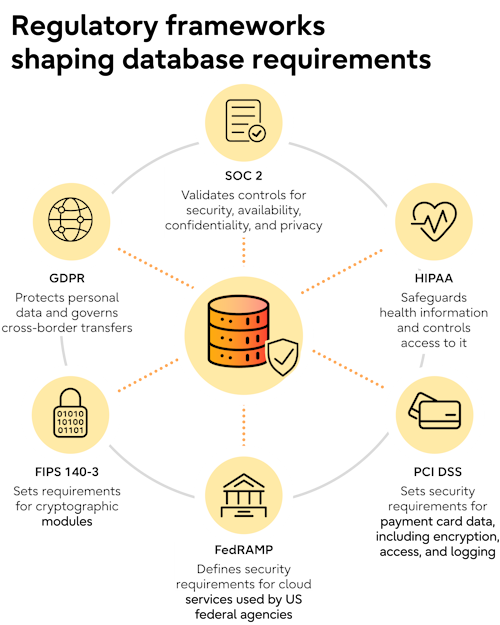
None of these dictates a particular database platform. Instead, they shape what organizations need to control, document, and demonstrate about how regulated data is stored and managed.
What an audit finding actually costs
The cost of an audit finding can extend well beyond a regulatory penalty, including:
- Remediation

Redesigning, implementing, testing, and documenting failed controls. - Investigation
Identifying affected systems, data, and related weaknesses. - Audit work
Producing evidence, reconstructing audit trails, and completing follow-up testing. - Infrastructure changes
Updating databases, applications, access models, encryption, or logging. - Operational resources
Diverting security, compliance, database, and IT teams from planned work.
The longer remediation takes, the more those costs can accumulate. For example, a US Government Accountability Office review of the Department of Veterans Affairs identified 442 system-specific findings, with two high-risk vulnerabilities still unresolved after 17 to 21 months despite a 60-day remediation requirement.
Legacy architecture can extend that burden when evidence must be reconstructed across multiple systems. Applying consistent security best practices for enterprise databases can make controls easier to enforce, monitor, and demonstrate.
The four architectural principles that make modernization audit-ready
There's no single feature that makes a database compliant. An audit-ready architecture combines four core principles that determine how sensitive data is protected, who can access it, what activity can be evidenced, and where that data resides.
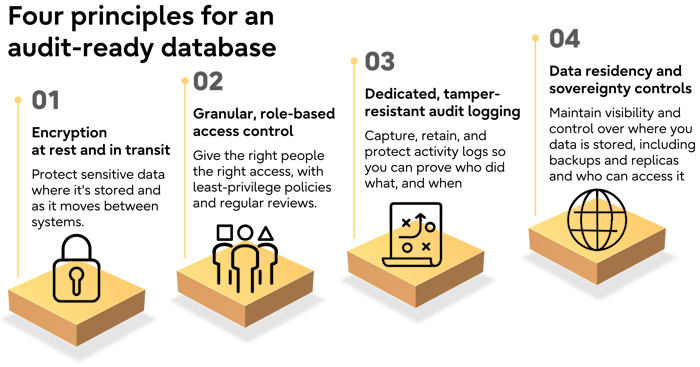
These principles are also useful when evaluating database capabilities for regulated environments.
1 Encryption at rest and in transit
Sensitive data needs protection at rest and in transit, using mechanisms such as transparent data encryption at the tablespace level. Data masking can further limit exposure in non-production environments. Teams should be able to show where encryption applies and how keys are managed.
2 Granular, role-based access control
Role-based access control, least-privilege policies, and recurring access reviews help restrict access to what each user actually needs. Security best practices for regulated environments align with NIST SP 800-53. Teams should be able to demonstrate who has access, why, and how permissions are reviewed and revoked.
3 Dedicated, tamper-resistant audit logging
Logging records activity; auditability determines whether those records provide defensible evidence. A dedicated audit log should capture relevant database activity separately from application logs, with appropriate retention and protection against alteration.
4 Data residency and sovereignty controls
Organizations need visibility and control over where regulated data is stored and who can access it across jurisdictions. Data sovereignty with PostgreSQL applies to production databases, backups, replicas, and support access. Teams should be able to identify where each resides and who can access it during a support incident.
Choosing a modernization path without compromising compliance posture
Once modernization is approved, organizations have three main PostgreSQL paths: community PostgreSQL, a hyperscaler-managed service, or an enterprise distribution. Each offers a different balance of control, operational responsibility, and provider dependency.
The right choice depends on in-house expertise, workload sensitivity, regulatory requirements, and how much compliance engineering the organization wants to manage itself.
| Consideration | Community PostgreSQL | Hyperscaler-managed service | Enterprise distribution |
| Compliance engineering | Managed in-house | Shared with provider | Typically integrated and vendor-supported |
| Audit logging | Configured and maintained in-house | Provider-specific database and cloud logging | Often integrated into the database platform |
| Data residency | Controlled through deployment choices | Limited to provider regions and service model | Depends on deployment model, often including on-premises, cloud, and hybrid |
| Operational responsibility | Organization-managed | Largely provider-managed | Shared |
| Vendor dependency | Lowest | Highest, particularly with provider-specific services | Moderate, depending on distribution and deployment model |
Community PostgreSQL: full control, full ownership of compliance engineering
 Community PostgreSQL offers maximum control, but organizations also own the compliance engineering, monitoring, maintenance, and evidence required around it. For teams with deep PostgreSQL expertise, that can provide significant flexibility.
Hyperscaler-managed services: convenience with residency and lock-in trade-offs
Hyperscaler-managed PostgreSQL reduces operational responsibility but increases provider dependency around residency, support access, and provider-specific services. For federal and other high-security workloads, those dependencies can also affect operational resilience.
Enterprise distributions: built-in compliance capabilities with vendor support
Enterprise PostgreSQL distributions combine vendor-supported capabilities with greater control over database deployment. Depending on the distribution, these can include encryption, audit logging, security tooling, lifecycle management, and support SLAs. Organizations still own their overall compliance posture, but manage less of the underlying database capability themselves.
A structured approach to compliance-ready modernization
Compliance-ready modernization should be treated as risk management from the outset, starting with data classification, dependency mapping, compliance gap analysis, and migration sequencing based on workload sensitivity.
Compliance obligations don't pause during a database migration. Audit logging, access reviews, and data handling requirements must continue across the source, target, and migration environment, while validation should cover both data integrity and audit-trail continuity through cutover.
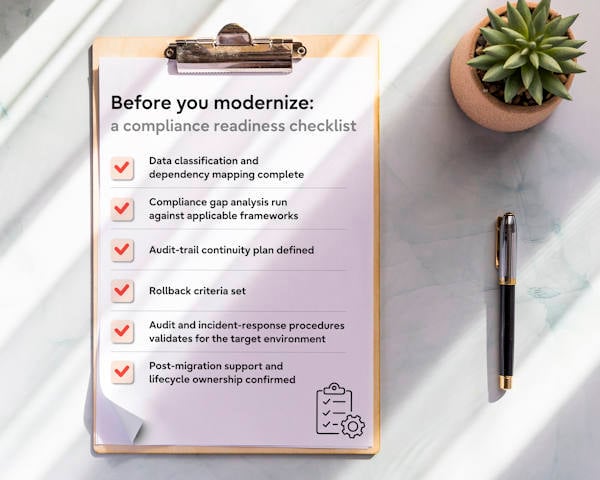
Before you modernize: a compliance readiness checklist:
- Data classification and dependency mapping complete
- Compliance gap analysis run against applicable frameworks
- Audit-trail continuity plan defined
- Rollback criteria set
- Audit and incident-response procedures validated for the target environment
- Post-migration support and lifecycle ownership confirmed
Building a modernization roadmap that holds up to audit
 A modernization roadmap that holds up to audit should deliver less audit friction, a defensible compliance posture, and an architecture that can adapt as requirements change. It should also reduce reliance on manual reconciliation, ad hoc extensions, and undocumented knowledge that can otherwise lead to cost overruns, timeline slippage, or an environment nobody fully understands after cutover.
For organizations considering an enterprise PostgreSQL distribution, Fujitsu Enterprise Postgres provides compliance-focused capabilities directly within the platform, including:
- Transparent data encryption to protect sensitive data at rest.
- Data masking to limit exposure of sensitive information to unauthorized users.
- Dedicated audit logging to create and maintain database audit records without assembling the audit trail from separate extensions.
- 24/7 global support with SLAs to provide ongoing expertise for the database environment.
Together, these capabilities reduce the amount of compliance infrastructure teams need to assemble and maintain around the database itself.
Talk to Fujitsu's specialists about what a compliance-ready modernization roadmap looks like for your regulatory environment.
Frequently asked questions about database modernization for regulatory compliance
Does regulatory compliance require moving to a new database platform?
Regulatory compliance does not require moving to a specific database platform. Most frameworks require demonstrable control over encryption, access, and audit trails, and some legacy systems can meet those requirements with enough engineering effort. In practice, retrofitting an older database with modern compliance controls often costs more than replatforming onto an environment where those controls are already built in.
What is the first step in a compliance-focused modernization program?
The first step in a compliance-focused modernization program is data classification and dependency mapping, not platform selection. Before choosing a destination, an organization needs a clear picture of which data is sensitive, which regulations apply, and which applications depend on the current database. That includes identifying data silos and dependencies that could complicate data migration. That inventory turns a decision into a plan with a defensible rationale.
What does database modernization for regulatory compliance involve?
Database modernization for regulatory compliance involves treating security, auditability, governance, and control enforcement as design requirements for the target database. In practice, that means encryption, granular access control, dedicated audit logging, observability, and clear data residency controls, built into a phased migration plan that keeps compliance obligations intact throughout. The broader data modernization effort may also involve refactoring applications or replatforming workloads where existing architecture prevents those controls from being applied consistently.
Which regulations should shape a database modernization strategy?
The regulations, standards, and frameworks that should shape a database modernization strategy depend on the organization's industry, data, and geography. US organizations commonly account for SOC 2, HIPAA, PCI DSS, and FedRAMP where federal systems are involved, while FIPS 140-3 sets security requirements for cryptographic modules used in applicable federal environments. Organizations operating internationally may also need to account for GDPR and its requirements around personal data and cross-border transfers. The same obligations continue to apply when regulated workloads move through cloud migration or into a cloud database.
How does database modernization improve audit readiness?
Database modernization improves audit readiness by making controls and audit evidence easier to apply, maintain, and demonstrate. Rather than reconstructing what happened after the fact, a compliance-ready database can provide structured audit trails, consistent access controls, and better observability across the database environment, reducing the manual work required to respond to audit requests.
What is the difference between database modernization and a database migration?
The difference between database modernization and a database migration is scope: migration moves data and schema, while modernization changes the underlying database environment and how it operates. A cloud migration, for example, is still a migration if the organization simply moves the existing workload into cloud computing infrastructure without changing its underlying architecture or controls. A migration can happen without improving compliance posture if the destination platform doesn't address the limitations of the underlying architecture.


 PostgreSQL Insider


