


 A core banking platform built in the 1990s wasn't designed to reconcile a fraud alert in real time, or to prove to an examiner exactly which system touched a customer record and when.

What database modernization means for financial services
 Database modernization in financial services means replacing or re-platforming legacy systems, whether that's a mainframe or a proprietary relational database, with a platform built for real-time transaction processing, continuous regulatory reporting, fraud detection, and AI-ready data pipelines. It's a change at the platform layer, not a version upgrade layered on top of the same architecture.
Modernization success is rarely measured by whether a migration completes. It's measured by whether the resulting platform can be governed, audited, secured, and operated consistently at enterprise scale. Swapping databases while retaining the same audit gaps and manual compliance workarounds simply moves the problems to a new platform.
Modernization vs. migration vs. infrastructure refresh
Financial IT teams often use these terms interchangeably, but each describes a different level of change:
- Infrastructure refresh

Updates the underlying hardware or infrastructure while keeping the same database engine and operational model. - Database migration

Moves data and workloads to a new system without necessarily changing how the database is governed, secured, or audited. - Database modernization

Changes the platform itself, often through replatforming, to support new operational, security, governance, and compliance requirements at scale.
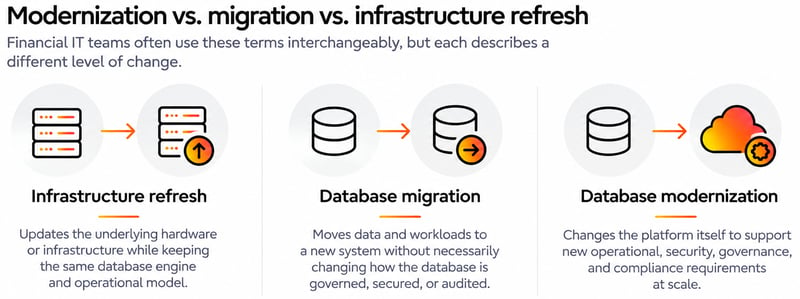
Modernization is therefore judged by what the target platform can sustain, not simply whether the data moved successfully. The goal is a platform that can support the institution's compliance and audit posture as its database requirements evolve.
Why financial institutions are under pressure to modernize now
The pressure is coming from three directions at once, against a backdrop of tightening requirements around data lineage, auditability, and regulatory reporting.
Real-time processing and fraud detection demands
 Payment rails, fraud detection, and customer-facing services increasingly run in real time, and batch-oriented legacy systems can't keep pace.
That constraint is still widespread. Accenture’s 2024 payments growth research found that 59% of banks struggle with legacy payments IT systems and infrastructure, limiting their ability to respond to customer demands quickly and affordably. A fraud pattern that used to surface in an overnight batch job now needs to be caught mid-transaction, and an architecture built around end-of-day processing windows wasn't designed for that.
AI and data readiness pressure
Financial institutions are also under pressure to make their data usable for AI models supporting fraud detection, credit risk scoring, and customer analytics. Moving data from decades-old schemas and batch extracts into machine learning pipelines while maintaining data quality has therefore become another modernization driver.
Escalating maintenance costs on aging infrastructure
Legacy infrastructure requires ongoing investment in maintenance, specialist skills, and support simply to keep existing systems running. That leaves less budget available for AI, digital transformation, and other modernization priorities.
The risks that make financial database modernization different
Financial workloads carry higher stakes than most industries. A failed database change can mean regulatory penalties, failed transactions, broken reconciliation, and significant operational disruption.
A financial modernization program therefore needs to address risks that may not arise in a typical IT project:
- Data integrity throughout the migration
Not just at cutover, since partial or delayed reconciliation during data migration in a financial system can mean unbalanced accounts. - Continuous audit trails during the transition itself
A gap in the audit record during a migration window can create a regulatory compliance issue. - A full application and integration dependency map before any cutover commitment
Legacy databases rarely stand alone; they feed reporting systems, fraud engines, APIs, and downstream services that may not be fully mapped until modernization begins. - Operational recovery and rollback readiness
If a modernization step doesn't go as planned, the institution needs a tested way back to a known-good state, not a scramble to reconstruct one under pressure. Institutions that build continuity planning and disaster recovery into their migration plans are better positioned to recover without turning a technical failure into prolonged business disruption.
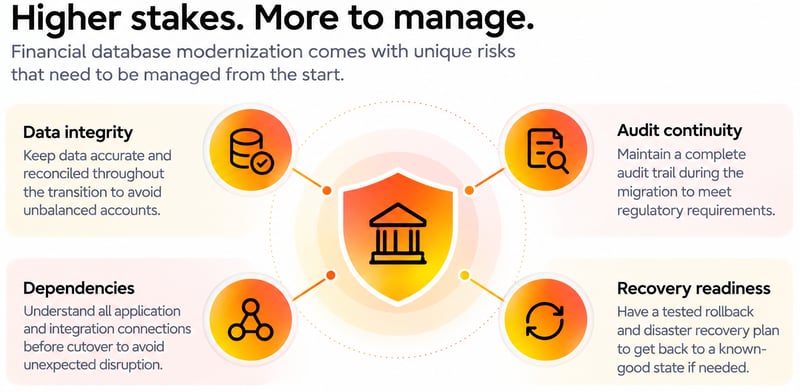
Structured migration risk management practices manage these categories together rather than as separate workstreams, reducing the chance that a dependency, control, or recovery requirement is discovered too late.
What a modern data platform needs to deliver for financial services
Modernization isn't just about replacing a legacy database with a newer one. Financial institutions need a platform that can support the security, resilience, deployment, and data requirements of a regulated, always-on environment.
Security, governance, and auditability as first-class requirements
 Security controls are only part of the picture. A modern platform also needs the governance, auditability, and traceability to show how data is accessed, changed, and used across the organization.
- Security and data governance
Encryption, audit logging, and granular access controls should be built into the platform. Financial institutions must also to trace which user, system, or process accessed or changed data and when. Security features built for regulated industries can bring these controls into the platform rather than adding separate layers to manage. - Operational resilience
Always-on transaction processing requires high availability through routine maintenance and unexpected failures, with recovery capabilities that limit disruption when something does go wrong. - Deployment flexibility
Support for on-premises, hybrid, and multi-cloud environments gives financial institutions more control over where data and workloads run as sovereignty, residency, and hybrid cloud strategy requirements change. - Analytics and AI readiness
Modern data architectures need to support real-time analytics and AI-driven fraud detection without requiring another major modernization effort as those workloads grow. A checklist of features regulated industries should prioritize can help turn these requirements into practical evaluation criteria.
The platform-form decision: community, hyperscaler, or enterprise distribution
Once an institution commits to modernizing, a second decision follows close behind: what form should the new database platform take? The options generally fall into three categories, each creating a different balance between operational control and external dependency.
| Dimension | Community PostgreSQL | Hyperscaler-managed service | Enterprise distribution |
| Support and SLAs | Community support, no contracted SLA | Provider-defined support and SLAs | Dedicated enterprise support with contracted SLAs |
| Governance and compliance responsibility | Managed by the institution | Shared between the institution and provider | Institution retains oversight, with additional vendor-supported capabilities |
| Deployment flexibility | Full flexibility, with greater internal operational responsibility | Typically tied to one cloud provider | On-premises, hybrid, and multi-cloud options |
| Long-term dependency | Low vendor dependency, higher reliance on internal PostgreSQL expertise | Greater dependency on the provider's platform, roadmap, and pricing | Greater vendor dependency than community PostgreSQL, with contracted support |
None of these is universally right.
- Community PostgreSQL maximizes control but requires deep in-house PostgreSQL database management expertise.
- Hyperscaler-managed, cloud-based databases reduce operational burden but increase dependency on one provider's roadmap and pricing.
- An enterprise distribution combines greater deployment control with contracted support and enterprise capabilities.
The choice depends on where the institution wants control and where it accepts dependency.
Fujitsu Enterprise Postgres: a supported foundation for financial services modernization
 Fujitsu Enterprise Postgres can complement a financial institution's broader database strategy rather than requiring an immediate rip-and-replace. Fujitsu Enterprise Postgres can run alongside existing systems, allowing workloads to move as the institution builds confidence in the new environment.
For financial services, three capabilities align particularly closely with the requirements of database modernization:
- Built-in security
Transparent data encryption, data masking, and dedicated audit logging support regulatory compliance and audit requirements. These capabilities reflect Fujitsu's long-standing investment in database encryption and security. - 24/7 enterprise support
Global support with contracted SLAs reduces the reliance on internal teams to provide around-the-clock database support themselves. - Deployment flexibility
Fujitsu Enterprise Postgres can run across on-premises, hybrid, and multi-cloud environments, as well as platforms including IBM Power and IBM LinuxONE. The full Fujitsu Enterprise Postgres feature set provides further capabilities for enterprise database environments.
A large US credit union chose Fujitsu Enterprise Postgres for transparent pricing, security, and lower total cost of ownership, while a capital markets operator migrated from MS SQL to Fujitsu Enterprise Postgres on OpenShift on IBM Z. Outside financial services, database modernization in manufacturing provides another example of Fujitsu Enterprise Postgres operating alongside existing systems.
Fujitsu Enterprise Postgres doesn't make database migration simple. Fujitsu brings a structured assessment methodology and experience to planning and managing a complex modernization effort.
Building a modernization roadmap you can defend
 A modernization program that can withstand internal scrutiny and an external audit follows a consistent sequence rather than skipping straight from decision to migration.
That preparation is critical. IBM’s core banking modernization research found that 94% of core banking modernization projects ran beyond their original schedules. More than half (53%) encountered challenges managing critical dependencies as changes were made to core systems.
A structured roadmap helps surface those dependencies early and address them in the right order:
- Assessment and dependency mapping
Catalog every system, application, integration, and workload connected to the current database before committing to a target platform or timeline. - Governance and compliance review
Confirm the regulatory compliance, data governance, security, and audit requirements the new platform must meet, and where the current environment falls short. - Platform evaluation
Weigh community, hyperscaler-managed, and enterprise-distribution database platforms against those requirements. - Migration planning
Build the detailed data migration and cutover plan, including rollback procedures, disaster recovery, and audit-trail continuity through the transition. - Operational readiness validation
Test the new platform under realistic transaction processing loads and failure scenarios before it takes on production traffic. - Production transition
Execute the cutover, with the recovery plan from step four ready if it's needed.
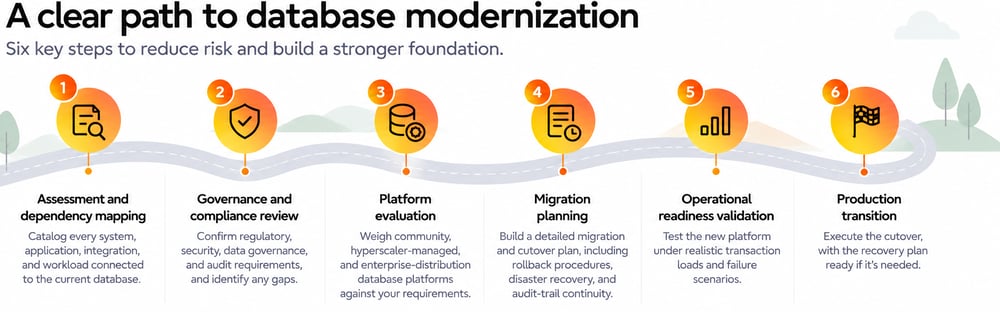
Each stage builds toward the same outcome: lower total cost of ownership, a stronger compliance and audit posture, and a data foundation ready for AI-driven fraud detection and real-time analytics. A technically successful database migration alone doesn't deliver those outcomes.
If your institution is weighing where to start, Fujitsu's modernization specialists can walk through what a migration or architecture assessment could reveal about your environment's cost, compliance, and risk posture.
Frequently asked questions about database modernization for financial services
What is database modernization in financial services?
Database modernization in financial services means replacing or re-platforming legacy mainframe or proprietary database systems with a platform built for real-time transaction processing, continuous regulatory reporting, fraud detection, and AI-ready data pipelines. It's a change to the platform's underlying architecture, not simply a version upgrade.
Why do financial institutions need to modernize legacy databases?
Financial institutions need to modernize legacy databases to support real-time processing, regulatory compliance, AI-driven analytics, and growing digital demands. Legacy databases often rely on batch-oriented architectures that struggle with real-time fraud detection, payment processing, or the compliance reporting regulators now expect. Maintenance costs on aging infrastructure also consume budget that could otherwise fund AI and digital initiatives.
What are the biggest risks in modernizing a financial services database?
The biggest risks are data integrity failures, gaps in audit trails, unmapped application dependencies, and inadequate recovery planning. Each can create operational and regulatory problems during a data migration, particularly if the risk isn't identified before cutover.
How does PostgreSQL support compliance requirements in financial services?
PostgreSQL can support financial services compliance through security, access control, auditing, and data governance capabilities. Enterprise-supported distributions can add capabilities such as transparent data encryption, granular access controls, and detailed audit logging to support regulatory requirements and demonstrate how sensitive data is protected and accessed.
Why are financial institutions adopting PostgreSQL?
Financial institutions are adopting PostgreSQL to reduce reliance on proprietary legacy databases while gaining greater flexibility and control over database costs and deployment. For institutions that also require contracted support, security capabilities, and SLAs, enterprise PostgreSQL distributions can provide these alongside the benefits of the PostgreSQL ecosystem.
What should a financial institution evaluate before modernizing a database platform?
A financial institution should evaluate its application dependencies, compliance and data governance requirements, operational resilience needs, deployment model, and support requirements before modernizing a database platform. It can then compare community PostgreSQL, hyperscaler-managed services, and enterprise distributions against those requirements before committing to a migration.


 PostgreSQL Insider


